
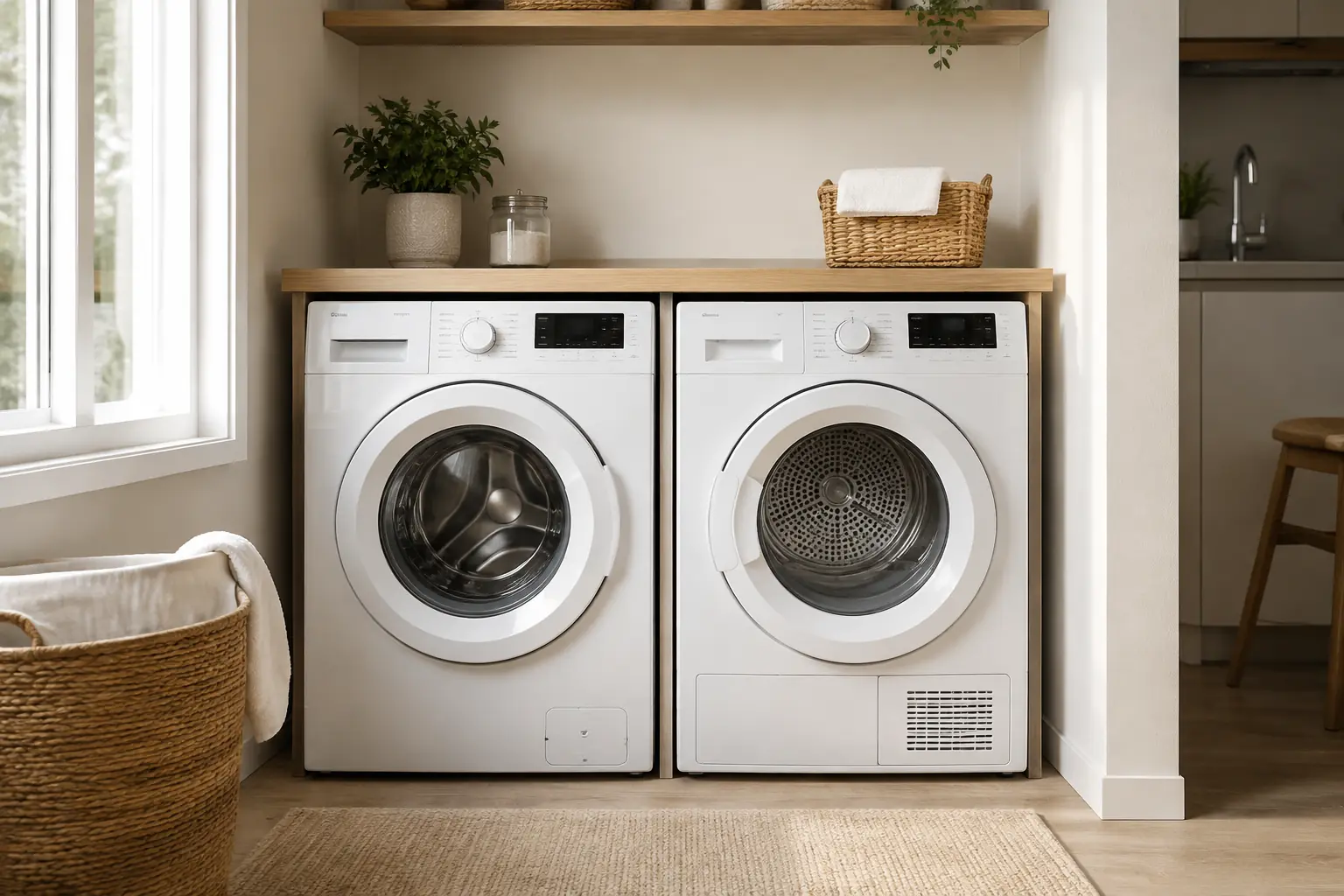
Typical compact washer and dryer dimensions are about 24 inches wide, 33 to 36 inches high, and 24 to 26 inches deep for each appliance. A side-by-side pair is commonly about 48 inches wide before clearances, while a stacked compact pair is often about 24 inches wide and 66 to 72 inches high. These are planning ranges, not guaranteed installation dimensions.
Actual compact machines can be slightly narrower than 24 inches or deeper than 26 inches. You must also account for water hoses, electrical connections, the dryer type, open doors, stacking hardware, and model-specific clearances. Check both specification sheets and installation manuals before ordering or building around a pair.
| Configuration | Typical appliance dimensions | What must be added or verified |
|---|---|---|
| One compact appliance | About 24 W x 33 to 36 H x 24 to 26 D in. | Exact width, height, depth, door-open depth, and clearances |
| Side-by-side compact pair | About 48 W x 33 to 36 H x 24 to 26 D in. | Outer-side space, gap between machines, and depth of the deeper appliance |
| Stacked compact pair | About 24 W x 66 to 72 H x 24 to 26 D in. | Approved stacking kit, completed stack dimensions, top and rear clearance |
Depth is especially easy to underestimate. For example, a current compact dryer can measure 26 3/8 inches deep even though general guides often stop their planning range at 26 inches. Always let the exact model determine the final opening.
Standard Compact Washer and Dryer Dimensions
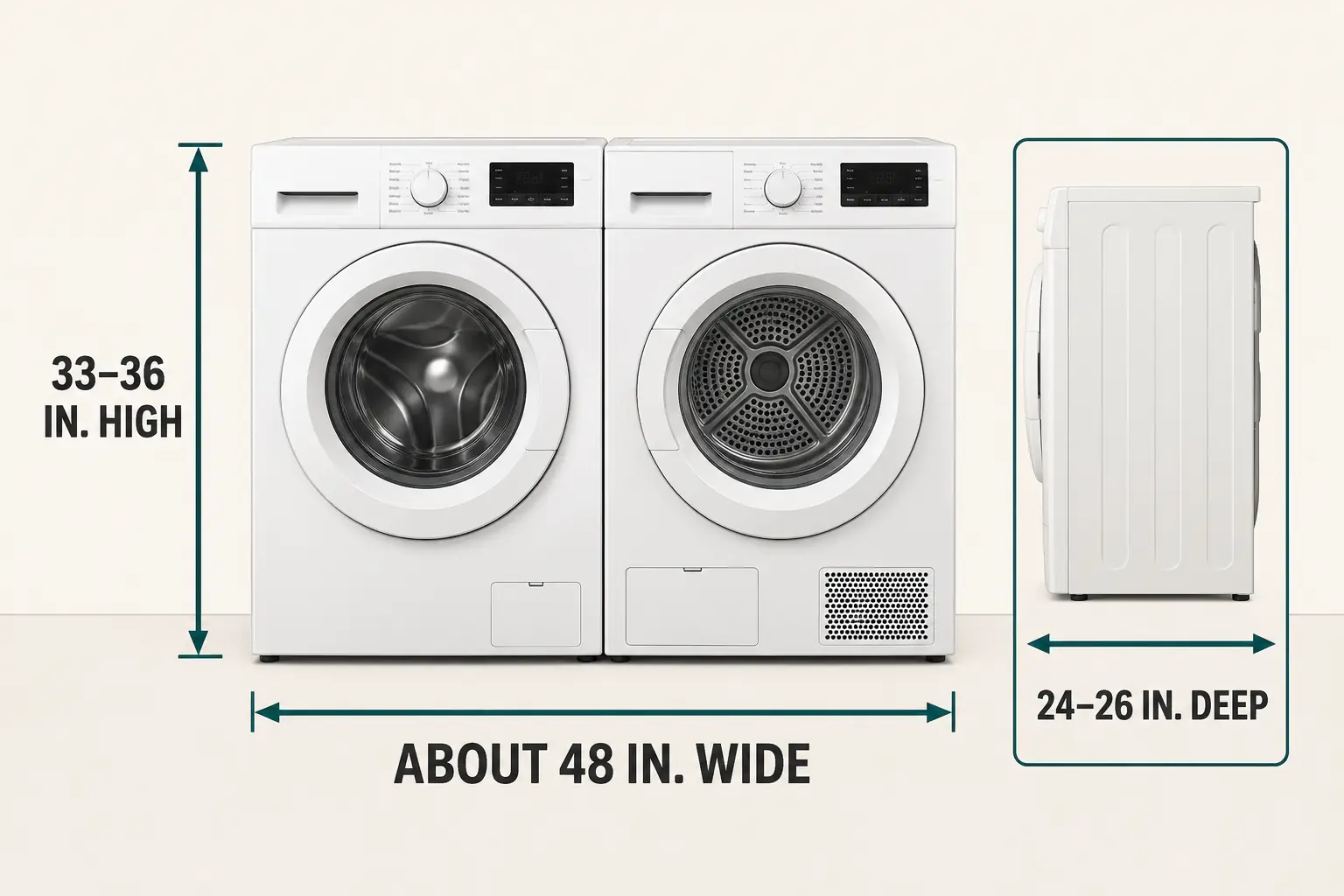
A nominal 24-inch width is the most useful starting point for compact laundry. However, 24 inches often describes the product class rather than an exact cabinet measurement. Some appliances are 23 7/16 or 23 1/2 inches wide, while others are exactly 24 inches wide.
Height commonly falls between 33 and 36 inches. That can make some compact front-load machines candidates for under-counter installation, but the appliance height alone does not confirm a fit. The opening must also accommodate leveling, any required top clearance, utility connections, and the countertop structure.
Cabinet depth varies within matching pairs. A compact washer may be shallower than its dryer, or the washer may be slightly deeper. For side-by-side planning, use the deeper appliance as the starting depth. Then add the rear space required by the applicable installation instructions.
Verified Compact Pair Size Examples
Current manufacturer specifications show how compact washer and dryer dimensions differ even among appliances marketed as 24-inch models. The examples below demonstrate dimensional variation; they are not product rankings or buying recommendations.
| Compact pair | Washer dimensions | Dryer dimensions | Pair footprint before clearances |
|---|---|---|---|
| Bosch WGB24600UC + WQB245AXUC | 23 1/2 W x 33 1/4 H x 25 1/2 D in. | 23 1/2 W x 33 1/4 H x 26 D in. | 47 W x 33 1/4 H x 26 D in. |
| LG WM1455HWA + DLHC1455W | 24 W x 33 1/2 H x 22 1/4 D in. | 24 W x 33 1/2 H x 26 3/8 D in. | 48 W x 33 1/2 H x 26 3/8 D in. |
| GE GFW148SSMWW + GFT14ESSMWW | 23 7/16 W x 33 1/4 H x 25 5/8 D in. | 23 7/16 W x 33 1/4 H x 25 1/4 D in. | 46 7/8 W x 33 1/4 H x 25 5/8 D in. |
The pair footprint is calculated from the appliance cabinets only. For width, the two appliance widths are added. For height and depth, the larger measurement in the pair is used. Required gaps and clearances are not included in the last column.
The LG example also shows why matching machines should be checked separately. Its washer is 22 1/4 inches deep, but its matching dryer is 26 3/8 inches deep. Planning from the washer alone would underestimate the pair’s cabinet depth by 4 1/8 inches.
Side-by-Side Compact Washer and Dryer Space
For side-by-side compact washer and dryer dimensions, begin by adding the two exact cabinet widths:
Pair cabinet width = washer width + dryer width
Two 24-inch appliances total 48 inches before any space is added between them or at the walls. The verified Bosch pair totals 47 inches, while the verified GE pair totals 46 7/8 inches. Those smaller totals do not mean either pair belongs in an opening of exactly the same width.
Use this complete calculation:
Required opening width = washer width + dryer width + left clearance + space between machines + right clearance
Take each clearance from the installation documents for the selected washer and dryer. If the two manuals differ, use the requirement that applies to each appliance and location. Do not automatically add a generic one-inch gap and call it final.
For additional pair-width examples and measurement guidance, see our side by side washer and dryer dimensions guide.
Stacked Compact Washer and Dryer Dimensions
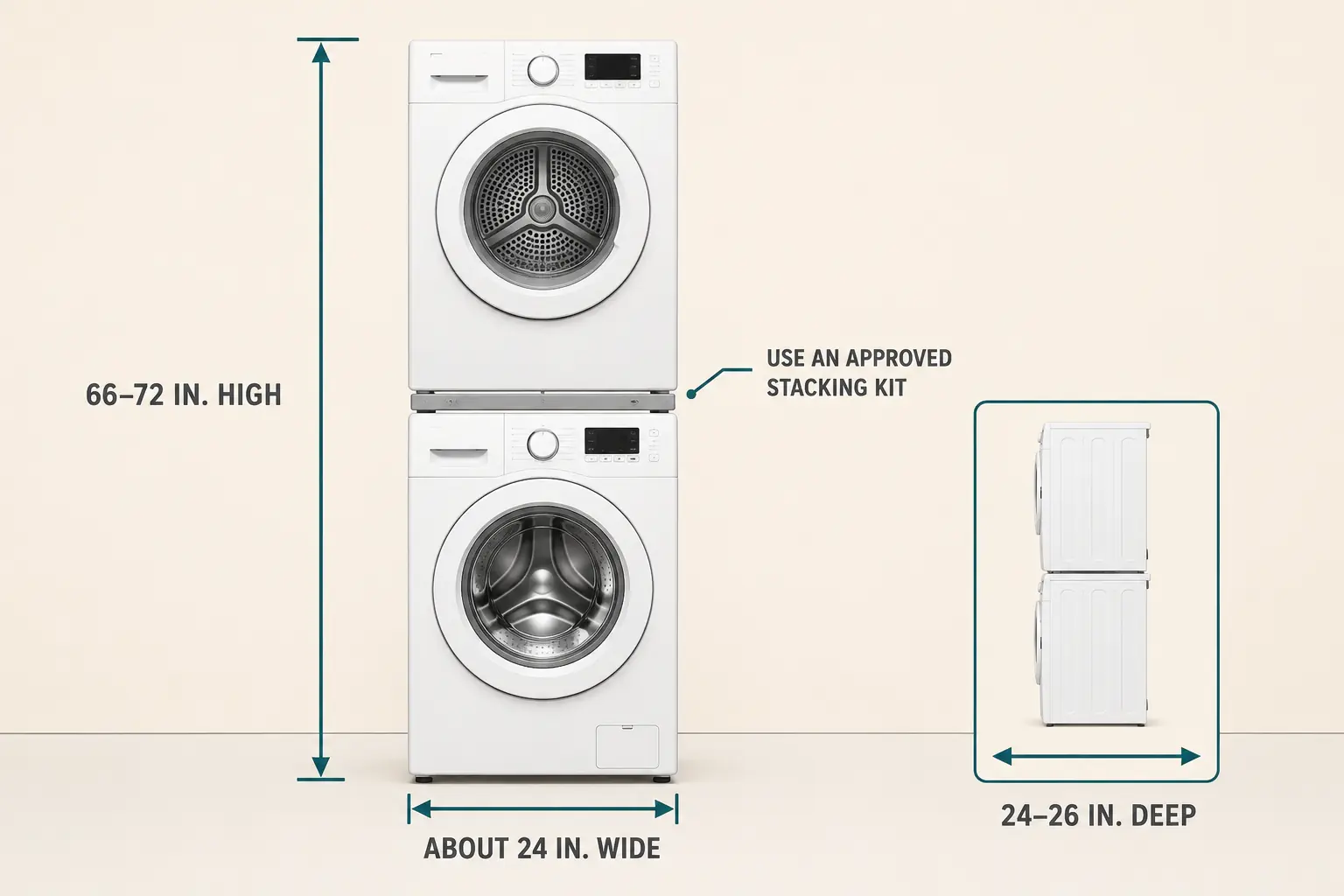
A compact stacked pair commonly needs about 24 inches of floor width and 66 to 72 inches of appliance height. That range is useful for screening a space, but the completed stack must be verified from the exact washer, dryer, and approved stacking kit.
Do not assume that any two 24-inch machines can be stacked. The manufacturer must identify the models as compatible, and the specified stacking hardware must be installed. The washer normally sits on the bottom because it is heavier and moves differently during operation.
A current LG planning document for the WM1455 and DLHC1455 compact pair lists the height to the top of the stacked appliances as 67 inches. For the illustrated recessed or closet setup, it also lists 1 inch at each side, 5 1/2 inches behind, 6 inches above, and 1 inch in front. Those clearances belong to that documented setup and should not be applied automatically to another brand or pair.
The same LG document specifies upper and lower ventilation openings for a closet with a door. This is a useful reminder that a ventless heat-pump dryer does not necessarily eliminate closet ventilation instructions. Ventless describes how the dryer handles exhaust; it does not mean every enclosed installation can be sealed without airflow.
For a full comparison of compact and full-size stacks, compatibility, and stacking-kit considerations, use our stackable washer and dryer dimensions guide.
Cabinet Size vs. Installation and Door Space
A compact label does not guarantee a shallow installed footprint. Four separate dimensions matter:
- Cabinet dimensions: the closed appliance width, height, and depth.
- Installed dimensions: the cabinet plus required room for hoses, cords, plugs, ventilation, and clearances.
- Operating dimensions: the space needed to open doors, load laundry, reach controls, and remove filters or water containers.
- Delivery dimensions: the appliance or packaged dimensions that must pass through doors, halls, stairs, and turns.
Door-open depth
The LG compact washer measures 22 1/4 inches deep when closed but 43 1/4 inches deep with its door open. Its matching dryer measures 26 3/8 inches deep when closed and 45 1/4 inches with the door open. A shallow cabinet can therefore fit inside an alcove while its open door blocks a narrow walkway.
Measure from the back wall to the nearest opposite wall, door, or traffic path. Then compare that distance with the manufacturer’s door-open depth. Also check the hinge side, door reversibility, and whether two side-by-side doors interfere with each other.
Rear connections
Water hoses, the drain hose, an electrical receptacle, plugs, trim, and utility boxes may sit behind the machines. The compact dryer may be ventless, but it still needs its required electrical connection and installation clearance. If the dryer is vented, the exhaust connection and duct route can increase installed depth further.
Never crush a hose or exhaust duct to make the pair fit. Use the exact installation drawings and connection locations rather than adding one universal rear-clearance number.
Under-counter installation
Many compact front-load machines are approximately 33 1/4 to 33 1/2 inches high, which is why they are often considered for under-counter layouts. Confirm the finished opening after flooring, countertop supports, and any required top clearance are included. A nominal counter height does not guarantee that the appliance can be installed, leveled, connected, and serviced beneath it.
How to Measure for a Compact Laundry Pair
Measure the room against the exact compact washer and dryer dimensions, not against the word “compact” on a product listing.
- Choose the configuration. Decide whether the pair will be side-by-side, stacked, or under a countertop.
- Confirm the exact model numbers. Download the specification sheet and installation instructions for both machines.
- Measure usable width. Check the opening near the floor, middle, and top. Record the narrowest point after accounting for trim, baseboards, and uneven walls.
- Measure usable height. Measure from the finished floor to the lowest countertop, shelf, cabinet, pipe, or ceiling obstruction.
- Measure usable depth. Measure from the back wall to the front boundary of the space or the nearest walkway obstruction.
- Map every connection. Record the locations of water valves, drain, receptacles, plugs, and any dryer exhaust.
- Add model-specific clearances. Use both manuals and the approved stacked-installation diagram when applicable.
- Check open doors. Compare door-open depth and hinge movement with walls, closet doors, and traffic paths.
- Check closet requirements. Confirm ventilation openings, door clearance, and any restrictions in the selected installation documents.
- Measure the delivery path. Check door trim, hallways, stair turns, handrails, elevators, and the final approach to the laundry space.
For definitions of cabinet, installed, operating, and delivery measurements across appliance types, see our main washer and dryer dimensions guide. You can also compare individual machine depth with our front load washer dimensions guide.
Compact Washer and Dryer Fit Worksheet
Complete each row using the exact pair and the narrowest available space. Tap each field to enter a measurement; entries may clear when the page is refreshed. Do not mark the setup as a fit until the required clearance, connection, door, and delivery checks all pass.
| Fit check | Available space | Required measurement | Space remaining |
|---|---|---|---|
| Side-by-side width | Both widths + all required gaps | ||
| Stacked height | Completed stack + top clearance | ||
| Installed depth | Deeper machine + rear requirement | ||
| Door-open depth | Largest open-door measurement | ||
| Narrowest delivery opening | Applicable appliance or package dimension |
Common Compact Laundry Fit Mistakes
- Treating 24 inches as exact: some compact machines are slightly narrower, while required openings may be wider.
- Using only the washer depth: the matching dryer may project several inches farther forward.
- Forgetting the door-open measurement: a closed machine can fit while its door blocks a hall or closet entrance.
- Assuming ventless means no clearance: electrical, service, airflow, and closet instructions still apply.
- Adding cabinet heights to plan a stack: use the manufacturer’s completed stacked dimensions and approved kit.
- Confusing appliance types: a compact pair, laundry center, all-in-one combo, and portable machine are not interchangeable.
- Ignoring delivery access: the appliances still need to pass through every doorway and turn.
Frequently Asked Questions
What is the standard size of a compact washer and dryer?
A useful planning range for each compact appliance is about 24 inches wide, 33 to 36 inches high, and 24 to 26 inches deep. Exact models can be slightly narrower, shallower, or deeper.
How wide is a compact washer and dryer side by side?
Two nominally 24-inch machines total about 48 inches in cabinet width. Verified pairs can total slightly less, such as 47 inches for the Bosch example. Add the required outer-side clearances and gap between machines before deciding the opening width.
How tall is a compact stacked washer and dryer?
Compact stacked pairs commonly fall around 66 to 72 inches in appliance height. A verified LG compact pair is listed at 67 inches to the top of the stacked appliances. Final height must include the applicable stacking hardware and required top clearance.
Will a compact washer and dryer fit in a 24-inch-wide closet?
Not necessarily. A nominal 24-inch appliance may need side clearance, and an exactly 24-inch opening leaves no installation margin. Use the actual product width and the closet-installation requirements for the exact pair.
Can compact washers and dryers go under a countertop?
Some models are designed for under-counter use, but height alone does not confirm compatibility. Verify the exact opening, leveling range, top and rear clearances, connections, counter supports, and service access.
Are all compact dryers ventless?
No. Ventless condenser and heat-pump compact dryers are common, but dryer venting varies by model. Confirm the dryer type, electrical requirements, drainage needs when applicable, and closet instructions before planning the installation.
Is a compact stacked pair the same as a laundry center?
No. A compact stacked pair consists of two compatible separate appliances secured with an approved stacking kit. A laundry center is manufactured as one combined assembly. Their dimensions, capacities, connections, and service requirements can differ.
Use typical compact washer and dryer dimensions to identify possible layouts, then make the buying decision from the exact pair. Confirm cabinet measurements, completed stacked or side-by-side size, connections, door movement, closet requirements, and the full delivery route before ordering.