
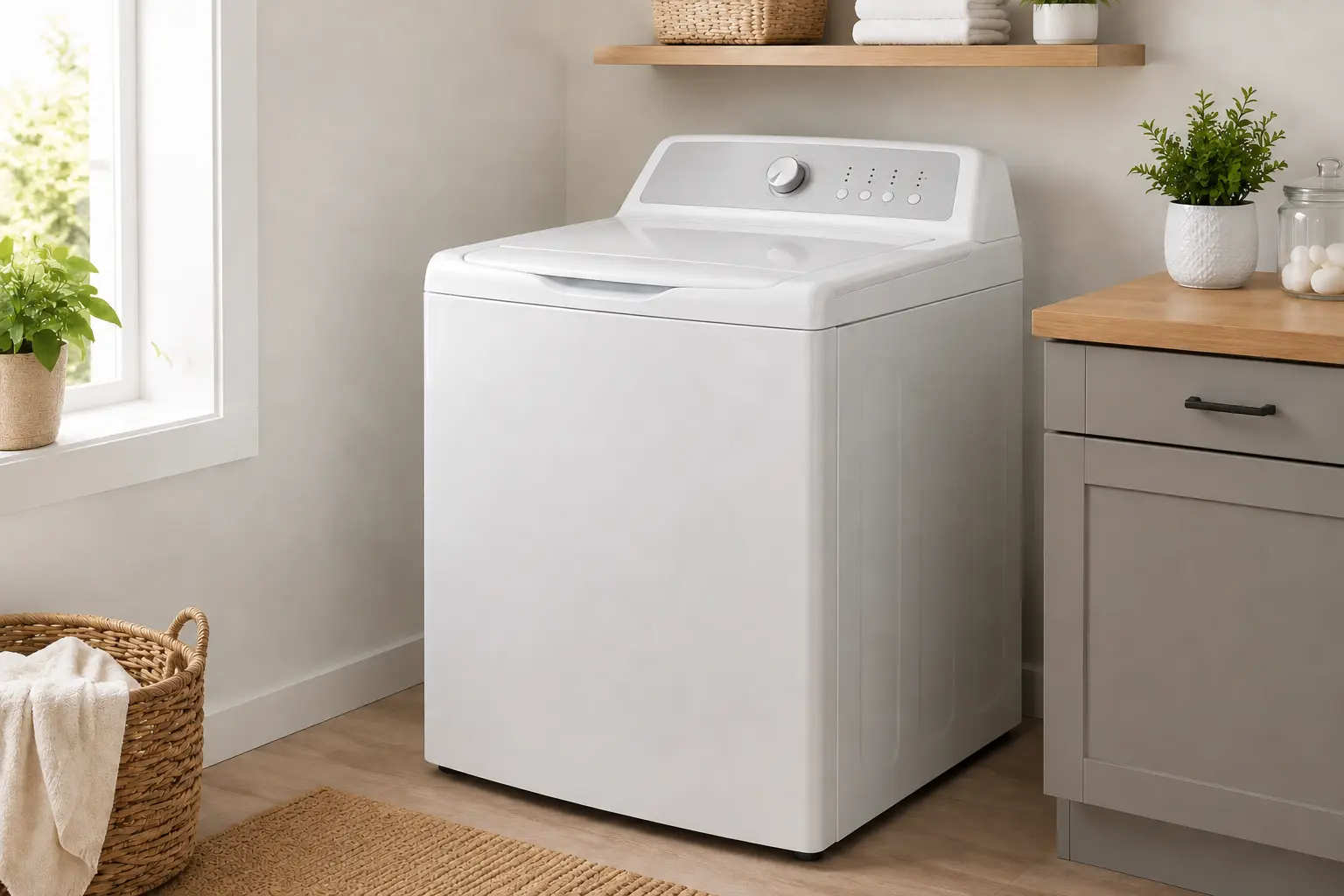
Typical top load washer dimensions are approximately 27 to 28 inches wide, 42 to 44 inches high, and 27 to 29 inches deep for many full-size models. These numbers are useful for early planning, but they do not describe every model. Large-capacity machines can be wider or deeper, and the height needed to raise the lid can be much greater than the washer’s closed height.
Before buying, check the exact width, overall height, depth, height with the lid open, installation clearances, and delivery path. The specification sheet tells you the appliance size. The installation instructions tell you how much usable space the machine actually needs.
| Measurement | Useful planning range | What to verify |
|---|---|---|
| Width | About 27 to 28 inches for many full-size models | Exact width and required side clearance |
| Closed height | About 42 to 44 inches | Whether the measurement includes the control console and leveling feet |
| Cabinet depth | About 27 to 29 inches for many models | Rear projections, hoses, valves, and connection space |
| Height with lid open | Often more than 50 inches | The exact lid-open height in the model specifications |
These ranges are planning guidance, not universal cutout requirements. Always use the documents for the exact model when confirming a purchase or preparing an opening.
Standard Top Load Washer Dimensions
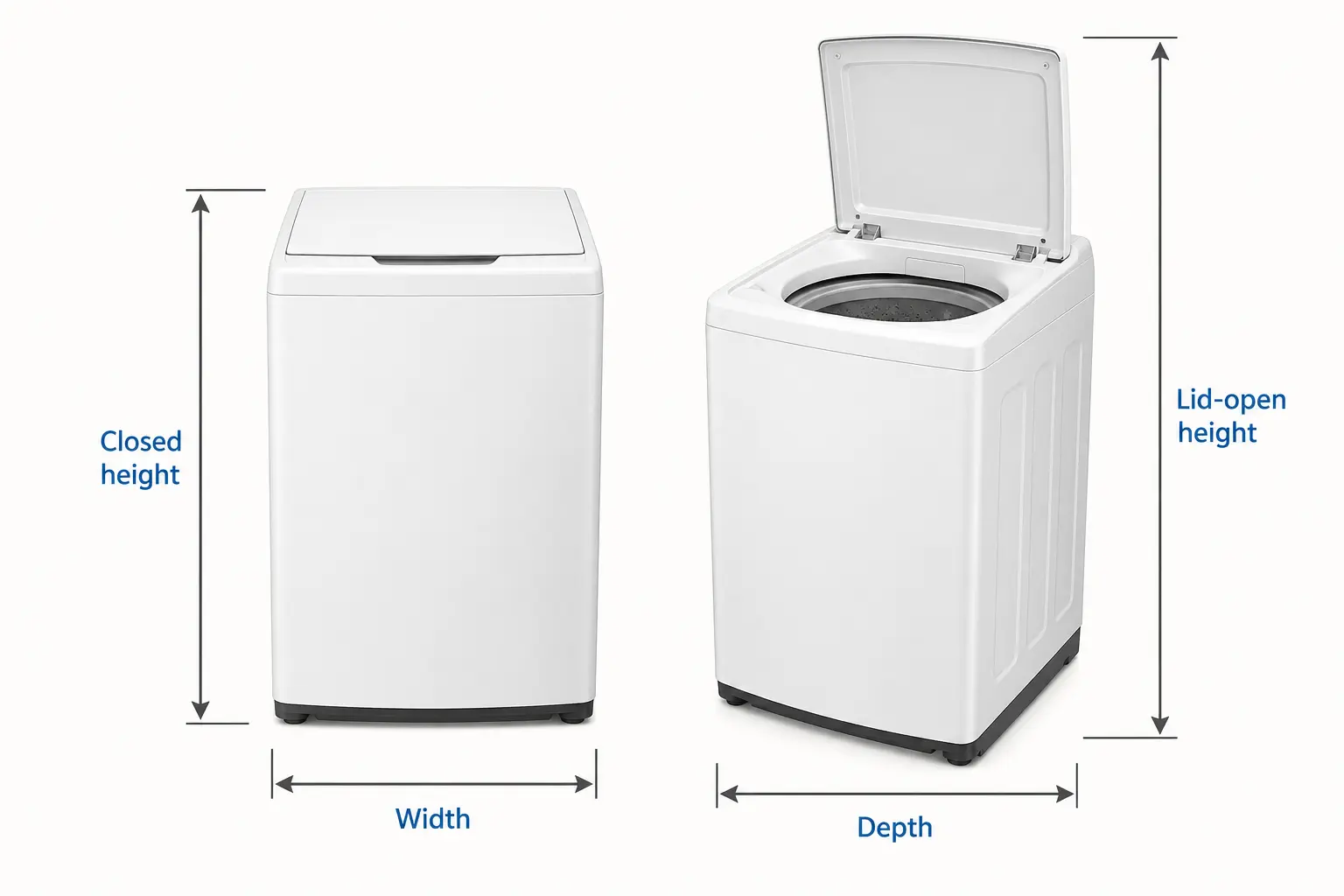
A 27-inch width is a practical starting point for a full-size top loader. Manufacturer sizing guides commonly place top load washers around 27 inches wide, 42 to 44 inches high, and 27 to 28 inches deep. However, top load washer dimensions vary by model. Actual products show that a machine may be 27 3/4 inches wide rather than exactly 27 inches, and some large-capacity models reach 29 inches in width and depth.
The three basic product measurements are:
- Width: the distance from one side of the washer to the other.
- Height: the distance from the finished floor to the washer’s highest point with the lid closed, usually the control console.
- Depth: the front-to-back dimension of the appliance as defined by the manufacturer.
Those dimensions answer only whether the physical cabinet can occupy the space. They do not automatically include all the room needed for hoses, water valves, the drain connection, servicing, vibration control, or opening the lid.
Verified Top Load Washer Size Examples
Current and recent manufacturer specifications demonstrate why one so-called standard size cannot guarantee a fit. The following examples are not product recommendations. They are included to show real dimensional variation.
| Model example | Width | Closed height | Depth | Height with lid open |
|---|---|---|---|---|
| LG WT6105CW | 27 in. | 44 1/2 in. | 28 3/8 in. | 57 1/4 in. |
| GE GTW485ASWWB | 27 in. | 44 in. | 27 in. | Verify in model documentation |
| Whirlpool WTW5010LW | 27 3/4 in. | 41 1/2 to 42 1/4 in. | 27 in. | 55 3/4 in. |
| Maytag MVW5435PW | 27 3/4 in. | 43 1/4 to 44 1/4 in. for its documented model family | 27 in. | 55 3/4 in. |
The LG specification sheet lists a 27-inch-wide cabinet but recommends a 29-inch-wide cutout. That difference illustrates the central fit rule: appliance dimensions and installation-space dimensions are not interchangeable.
Model specifications can also present height in several ways, including height to the top of the lid, height to the control panel, adjustable height with leveling feet, and total height with the lid open. Read the label attached to each number before comparing machines.
How Much Height Is Needed With the Lid Open?
The lid is the measurement most likely to cause trouble under a shelf, countertop, or wall cabinet. A washer that stands 44 inches high while closed may need approximately 56 to 58 inches of total vertical space to open fully. Other models can require less or more.
Use this calculation:
Available overhead space = height to the lowest obstruction – washer closed height
Suppose the underside of a shelf is 60 inches above the floor and the selected washer is 44 1/2 inches high when closed:
60 – 44 1/2 = 15 1/2 inches of space above the closed washer
That result alone does not confirm the fit. Compare the 60-inch shelf height directly with the manufacturer’s full lid-open height. For the LG WT6105CW example, the listed lid-open height is 57 1/4 inches. A 60-inch obstruction would therefore leave 2 3/4 inches above the fully raised lid, before considering how the shelf projects over the machine.
Projection matters because a shallow shelf may sit above the rear console without crossing the lid’s movement, while a deep cabinet may block it. Check both the vertical height and the path followed by the lid. If space is close, use the manufacturer’s dimensional drawing rather than assuming the lid rises straight up.
Appliance Depth vs. Installed Depth
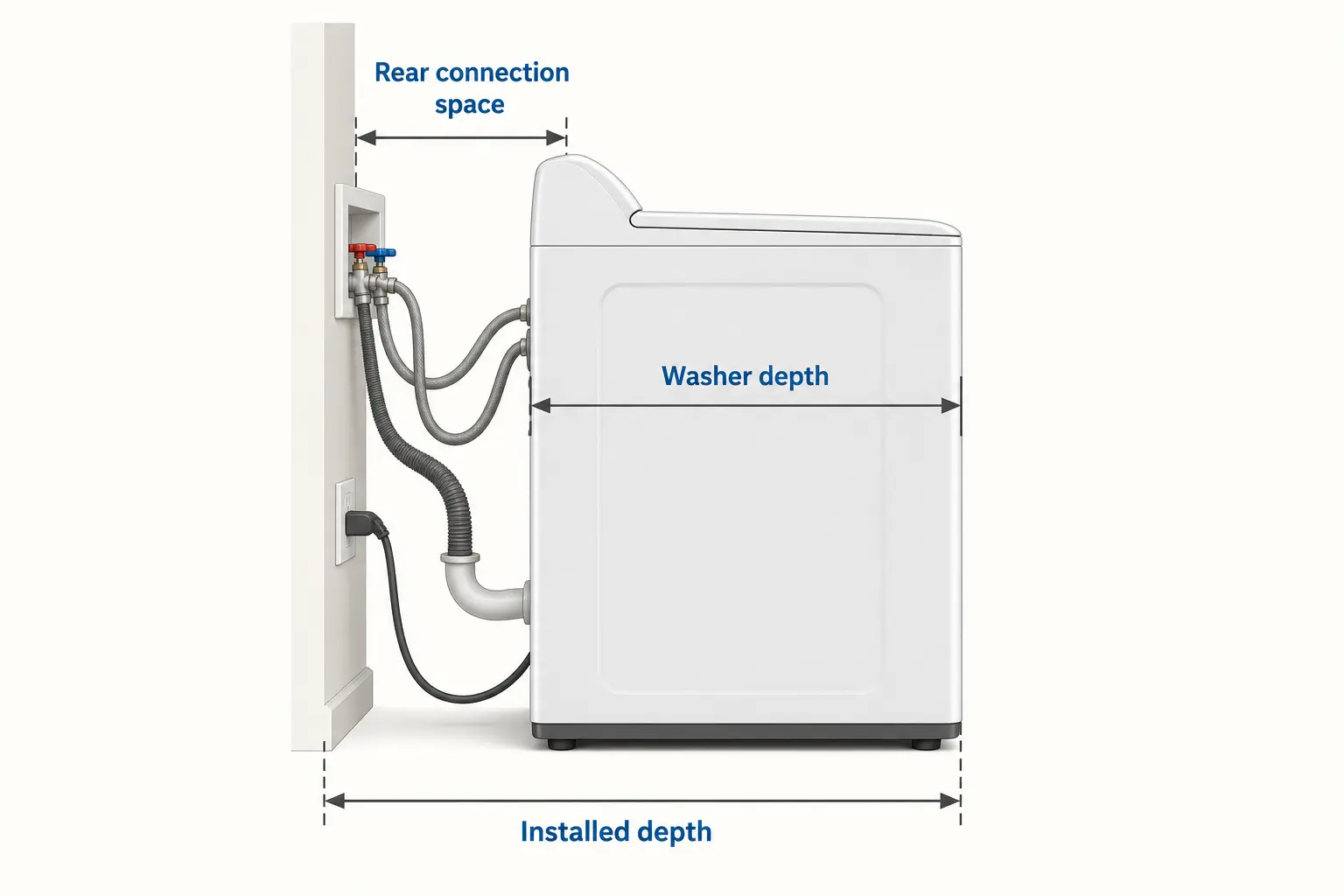
Cabinet depth describes the washer, but installed depth includes whatever must remain behind it. Water inlet hoses, a drain hose, plugs, valves, and wall moldings can prevent the cabinet from sitting at the nominal depth.
Use this planning formula:
Installed depth = washer depth + required rear connection space
If a washer is 28 3/8 inches deep and its installation plan calls for 4 inches behind it, the planning depth is 32 3/8 inches. This is an example calculation, not a clearance requirement for every washer.
Do not force the machine backward by sharply bending or crushing a hose. Check where the valves and standpipe are positioned because connections directly behind the washer may require more room than connections placed beside it. Follow the model’s installation instructions for the final spacing.
If the top loader will sit beside a dryer, the washer and dryer may not have matching depths. Use the deeper installed measurement when planning a straight front edge or a narrow walkway. Our side by side washer and dryer dimensions guide explains how to calculate the complete pair width and depth.
How to Measure for a Top Load Washer
Measure the space and compare it with the exact top load washer dimensions before ordering. Use the following steps so the appliance, connections, lid, and delivery path are all included.
- Record the exact model number. Download its specification sheet and installation instructions. A general retailer category page is not enough for a close fit.
- Measure usable width. Measure the opening at the front, middle, and back. Use the narrowest result after accounting for trim, baseboards, pipes, and uneven walls.
- Measure to the lowest overhead obstruction. Start at the finished floor and measure to the underside of the lowest shelf, cabinet, pipe, or sloped ceiling.
- Compare lid-open height. Confirm that the lid can rise fully and that a projecting cabinet will not cross its path.
- Measure usable depth. Measure from the back wall to the front boundary of the laundry space, then include the required room for hoses and connections.
- Locate the utilities. Record the positions of the hot and cold valves, drain, and electrical outlet. Their locations can change the installed footprint.
- Check working space. Make sure you can stand in front of the washer, reach into the basket, and carry a laundry basket without blocking a door or main walkway.
- Measure the delivery route. Check exterior doors, interior doors, halls, stairs, handrails, landings, and tight turns. Use the packaged dimensions when the manufacturer supplies them.
For a broader explanation of cabinet, installed, operating, and delivery measurements, see the main washer and dryer dimensions guide. If you are still choosing a loading style, compare this page with our front load washer dimensions guide.
Top Load Washer Fit Worksheet
Fill in the worksheet using the exact model documents and your own measurements. Tap each field to enter a measurement; entries may clear when the page is refreshed. A positive remaining-space result is useful only when every manufacturer requirement has also been met.
| Fit check | Available space | Appliance plus required clearance | Space remaining |
|---|---|---|---|
| Width | Washer width + required side space | ||
| Closed height | Closed washer height | ||
| Lid-open height | Full lid-open height | ||
| Installed depth | Washer depth + rear connection space | ||
| Narrowest delivery opening | Applicable appliance or packaged dimension |
Recheck any line with little remaining space. Real openings can narrow because of hinges, door stops, baseboards, protruding valves, or walls that are not square.
Common Top Load Washer Measuring Mistakes
- Planning from the old washer: a new machine with similar capacity may have different exterior dimensions.
- Using 27 inches as an exact width: some washers listed in this size class are 27 3/4 inches wide.
- Measuring only the closed height: the lid may hit a shelf or cabinet before it opens fully.
- Ignoring the control console: overall height may be measured to a point higher than the closed lid.
- Treating cabinet depth as installed depth: hoses, valves, plugs, and moldings can push the machine forward.
- Assuming capacity determines exterior size: two washers with similar cubic-foot capacities can have different widths, depths, or lid geometry.
- Skipping the delivery route: fitting in the laundry area does not mean the washer can pass through every doorway and turn.
- Using general guidance as a requirement: only the exact model documentation can provide its final installation measurements.
Frequently Asked Questions
What is the standard size of a top load washer?
Many full-size top load washers are approximately 27 to 28 inches wide, 42 to 44 inches high, and 27 to 29 inches deep. Treat those figures as planning ranges. Exact dimensions vary by model.
Are all top load washers 27 inches wide?
No. A nominal 27-inch width is common, but some models are 27 3/4 inches wide and some large-capacity machines are approximately 29 inches wide. Measure from the exact specification sheet.
How high is a top load washer with the lid open?
It depends on the model. Verified examples extend from the low 50-inch range to nearly 60 inches. Do not calculate the answer from closed height alone; locate the manufacturer’s lid-open measurement.
Will a top load washer fit under a 60-inch shelf?
Many models may fit, but 60 inches does not guarantee enough room. Compare the shelf height and depth with the exact lid-open height and lid path. For example, a washer with a listed lid-open height of 57 1/4 inches has 2 3/4 inches of vertical space below a 60-inch obstruction, but a deep shelf could still interfere with the moving lid.
How much space should be left behind a top load washer?
The correct rear space depends on the model and the positions of its hoses, drain, valves, outlet, and wall moldings. General planning guides may use several inches, but the selected washer’s installation instructions should decide the final amount.
Can a top load washer be installed beneath a countertop?
A fixed countertop directly above the washer usually prevents normal top loading unless the layout provides a large unobstructed opening. Confirm the full lid movement, loading access, required clearances, and service access before designing cabinetry around a top loader.
Start with the typical top load washer dimensions only for early planning. Before ordering, verify the exact model’s width, closed height, depth, lid-open height, required installation spacing, utility layout, and delivery route. Those checks determine whether the washer will fit and remain practical to use.