
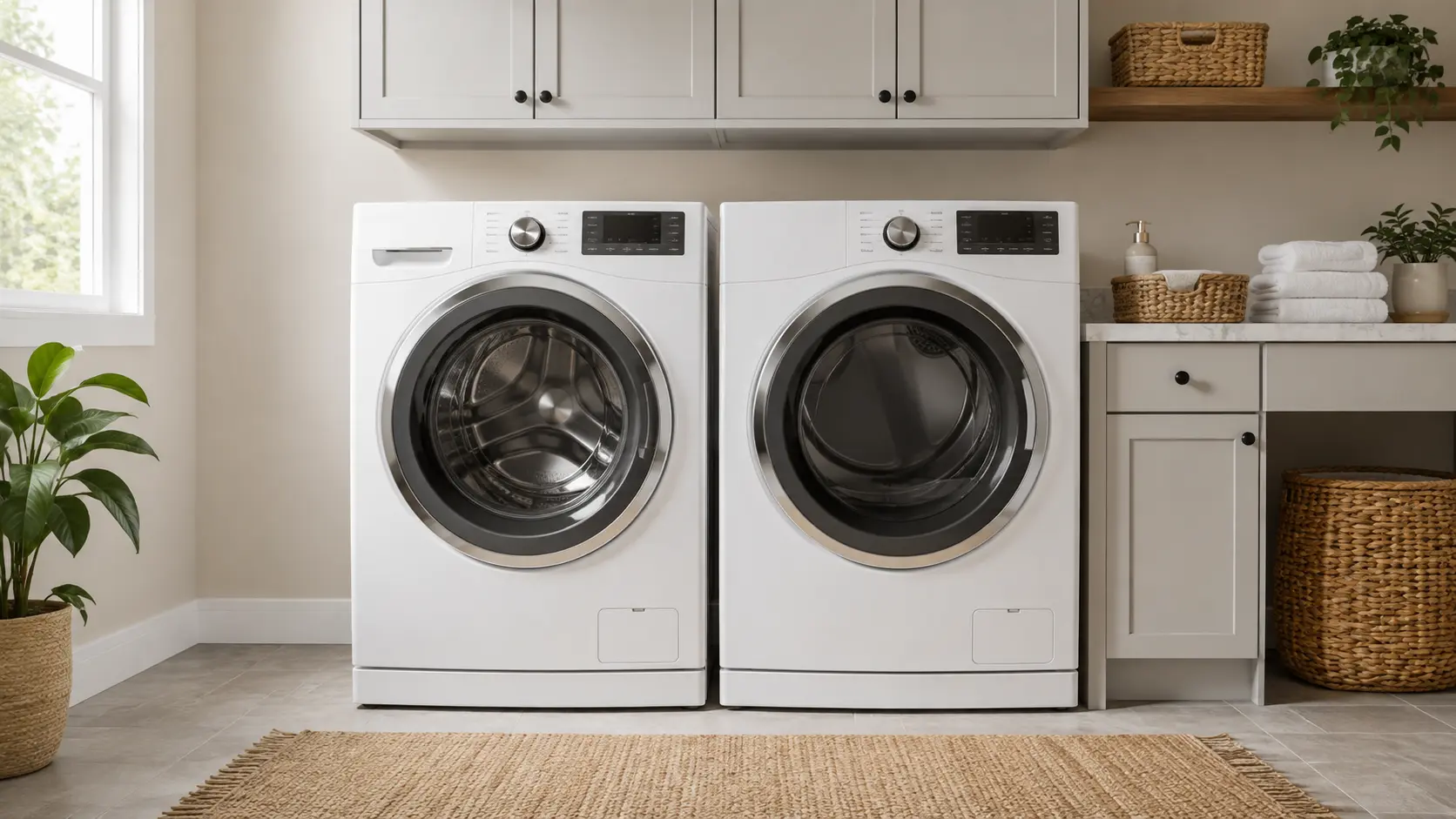
Typical side by side washer and dryer dimensions are about 54 inches wide, 39 inches high, and 32 to 34 inches deep before installation space is added. That is a useful starting point, not a universal size. Two 27-inch-wide machines total 54 inches, but the opening must also accommodate the gap between the machines and any clearance required at the outer sides.
For example, if the installation instructions call for 1 inch at each outer side and you plan a 1-inch gap between the washer and dryer, a 54-inch pair needs a 57-inch opening. A 60-inch opening would leave 3 inches beyond that example layout. Always calculate from the exact washer and dryer specifications because compact models can be about 23.5 inches wide, while some larger machines are 28 inches wide.
| Pair example | Appliance width | Combined machine width | Example opening* |
|---|---|---|---|
| Compact pair | 23.5 inches each | 47 inches | 50 inches |
| Common full-size pair | 27 inches each | 54 inches | 57 inches |
| Wider full-size pair | 28 inches each | 56 inches | 59 inches |
*The example opening adds 1 inch at the left wall, 1 inch between the machines, and 1 inch at the right wall. These are planning examples, not requirements for every model. Use the larger applicable clearance from the washer and dryer installation instructions.
How Much Space Do Side by Side Washers and Dryers Need?
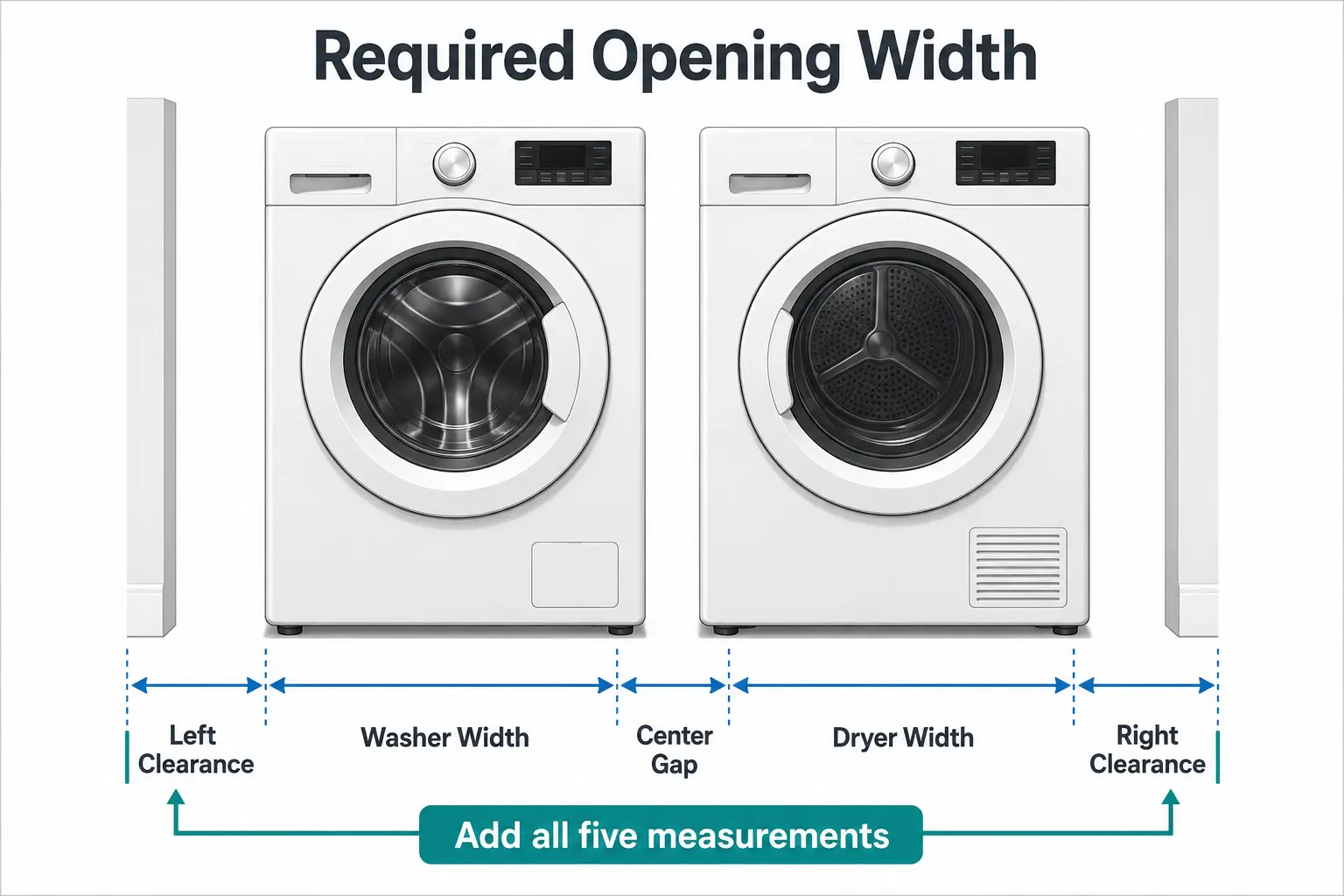
Many full-size side-by-side pairs need an opening in the upper 50-inch range. When comparing side by side washer and dryer dimensions, remember that a 60-inch-wide opening can accommodate many pairs made from two 27- or 28-inch machines, but width alone does not confirm a fit. You also need enough installed depth, usable height, door or lid clearance, and space for hookups.
The most reliable width calculation is:
Required opening width = washer width + dryer width + left-side clearance + gap between machines + right-side clearance
Do not automatically add a generic clearance value. Read both installation guides and use the larger applicable requirement when the instructions differ. A dryer manual may permit very small side clearance while the washer manufacturer recommends extra space to reduce vibration and noise.
For a broader overview of individual appliance sizes, see the complete washer and dryer dimensions guide. If you are deciding whether to use vertical rather than horizontal space, compare these measurements with the stackable washer and dryer dimensions guide.
If you’re planning built-in cabinetry around the pair, see our washer dryer cabinet dimensions guide for clear opening, cutout, and service-access planning.
Typical Side by Side Washer and Dryer Dimensions
The familiar 54-inch-wide pair comes from placing two 27-inch machines next to each other. The Whirlpool laundry sizing guide uses about 54 inches wide, 39 inches high, and 32 to 34 inches deep as a general side-by-side baseline. Actual models show why one standard number cannot cover every purchase.
| Official example | Washer size | Dryer size | Pair footprint before clearances |
|---|---|---|---|
| Bosch WGB24600UC washer and WQB245AXUC dryer | 33.25 H x 23.5 W x 25.5 D inches | 33.25 H x 23.5 W x 26 D inches | 47 W x 33.25 H x 26 D inches |
| LG WM4000 washer and DLEX4000 dryer | 39 H x 27 W x 30 1/4 D inches | 39 H x 27 W x 30 1/8 D inches | 54 W x 39 H x 30 1/4 D inches |
| GE GFW655SPVDS washer and GFD65ESPVDS dryer | 39.75 H x 28 W x 32 D inches | 39.75 H x 28 W x 32 D inches | 56 W x 39.75 H x 32 D inches |
These official examples illustrate three practical points:
- Width is added. Place two 27-inch machines together and their appliance width is 54 inches.
- Height is not added. The pair height is the height of the taller machine, unless pedestals or overhead requirements add more.
- Depth is not added. Start with the deeper machine, then add the rear space needed for hoses, cords, water connections, and the dryer vent.
A matching washer and dryer can have different depths. In the Bosch compact example, the washer is 25.5 inches deep while the matching dryer is 26 inches deep. Even a small difference matters if you want the fronts aligned or plan to place a countertop above the pair.
How to Calculate Whether a Pair Will Fit
1. Calculate the installed width
Add the washer width, dryer width, outer-side clearances, and the planned or required gap between the machines.
For two 28-inch machines with 1 inch at each outer wall and 1 inch between them:
28 + 28 + 1 + 1 + 1 = 59 inches
That example fits within a 60-inch opening with 1 inch left over. It does not prove that every 28-inch pair fits, because moldings, uneven walls, utility boxes, and model-specific clearances can reduce the usable width.
2. Calculate the installed depth
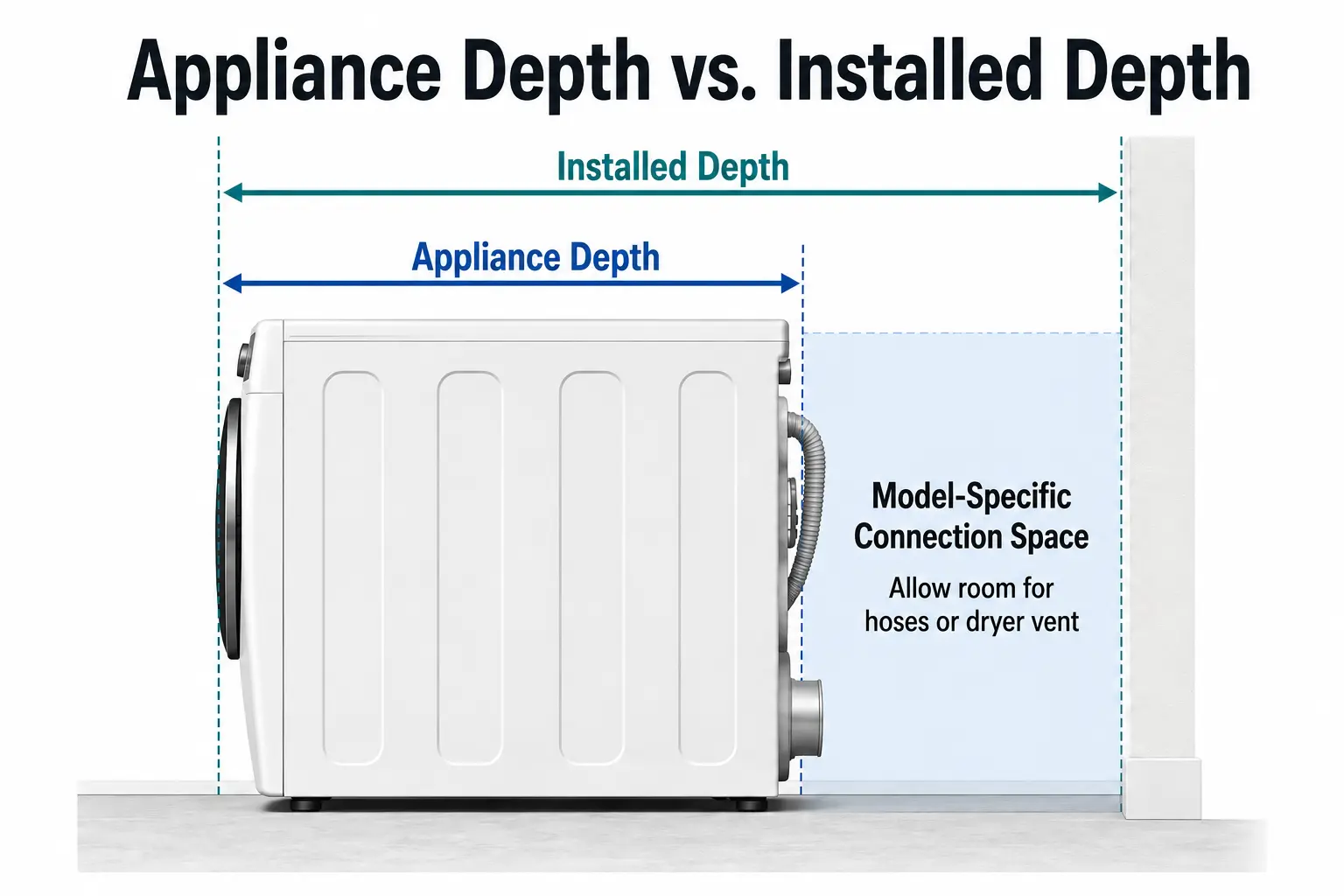
Use the depth of the deeper appliance and add the rear connection space required by the relevant manuals. Do not assume the cabinet depth is the installed depth.
Installed depth = deeper appliance depth + required rear connection or vent space
A 34-inch-deep washer with a 4-inch rear allowance produces a 38-inch planning depth. A vented dryer may need more room if its exhaust elbow projects farther from the wall. Some Whirlpool dryer instructions, for example, state that most installations need 5 inches behind the dryer for an exhaust vent with an elbow.
3. Calculate the usable height
Use the taller machine and include leveling feet, a pedestal if installed, and any required top clearance. For a top-load washer, measure the space needed to open the lid fully. Do not use the closed-lid appliance height as the only height measurement.
Side by Side Washer and Dryer Clearance Requirements
General sizing guides commonly suggest about 1 inch at the sides and several inches behind the machines. Treat those figures as early planning guidance. The final installation must follow the manuals for the exact washer and dryer.
The difference between minimum and recommended clearance is easy to miss. A manual may show a very small tested minimum while recommending more room for installation, servicing, vibration control, wall moldings, hoses, or the dryer exhaust connection.
- The official LG WM4000 washer manual calls for at least 1 inch at the sides and 4 inches behind the washer for hoses and airflow.
- Samsung’s dryer installation guidance says to keep at least 4 inches behind the dryer for the vent and to use the higher clearance when the paired washer requires more.
- Some Whirlpool vented dryer instructions say most installations require 5 inches behind the dryer when an exhaust elbow is used.
These values are not contradictory once the installation context is preserved. They refer to different machines and connection arrangements. A ventless heat-pump dryer, a rear-vented dryer with a standard elbow, and a dryer connected through a recessed vent box do not necessarily produce the same installed depth.
Also check closet or alcove ventilation requirements separately. A door opening, louver area, or airflow requirement is not the same thing as the physical gap beside an appliance.
How to Measure a Side-by-Side Laundry Space
- Measure width at three heights. Check near the floor, at the appliance body, and near the top. Use the narrowest measurement if walls or trim are uneven.
- Measure usable depth. Measure from the back wall to the nearest door, walkway, or obstruction. Record the depth of baseboards, valves, drain pipes, receptacles, and the dryer vent connection.
- Measure height. Measure from the finished floor to the lowest cabinet, shelf, countertop, or sloped ceiling.
- Map the connections. Confirm that fill hoses, the drain hose, power cords, a gas connection when applicable, and the dryer exhaust can reach without being crushed or kinked.
- Check door and lid movement. Make sure front doors can open without hitting a wall or each other. For a top-load washer, measure with the lid fully open.
- Measure the delivery path. Check exterior doors, interior doors, hallways, stair turns, and the final doorway. Appliance dimensions do not guarantee that the machines can be moved into the room.
- Compare with both manuals. Use the exact product dimensions and installation diagrams before ordering.
Common Side-by-Side Fit Mistakes
- Using 54 inches as the required opening. That is only the combined cabinet width of two 27-inch machines. It leaves no space for outer clearances or a gap between them.
- Adding both depths together. Side-by-side depth is based on the deeper machine, not the sum of both depths.
- Ignoring the dryer vent elbow. The exhaust connection can make the installed dryer project farther into the room.
- Assuming a matching pair has identical dimensions. The washer and dryer may have different depths or door-open measurements.
- Measuring wall to wall only once. Trim, bowed walls, or an uneven opening can make the usable width smaller at another height.
- Forgetting pedestals and countertops. A pedestal changes height, and a countertop must clear the machines while allowing for vibration and service access.
- Checking the room but not the route. A pair that fits the final opening can still be too large for a doorway or stair turn.
Frequently Asked Questions
Will a side-by-side washer and dryer fit in a 60-inch space?
Many pairs will, but not every pair. Two 27-inch machines total 54 inches, and two 28-inch machines total 56 inches before clearances. Use the exact widths and the clearance formula. In the example that adds 1 inch at each outer side and 1 inch between machines, a 27-inch pair needs 57 inches and a 28-inch pair needs 59 inches.
Are all full-size washers and dryers 27 inches wide?
No. A 27-inch width is common, but official products include compact machines around 23.5 inches wide and larger machines around 28 inches wide. Check each model rather than relying on the category name.
How deep should the laundry space be?
Start with the deeper machine, then add the rear space required for hoses, cords, valves, and the dryer vent. A pair with a 34-inch-deep appliance and a 4-inch rear allowance needs about 38 inches of planning depth before considering front door swing or walkway space. The exact requirement remains model-specific.
How much space should be left between the washer and dryer?
One inch is common planning guidance, but it is not a universal installation requirement. Use the washer and dryer manuals, and choose the larger applicable clearance if the two documents differ.
Should the washer go on the left or right?
Place the machines so their doors do not block each other and the hookups remain practical. Door reversibility varies by model, so confirm the hinge options before purchase. The available water, drain, gas, electrical, and vent locations may determine the most practical order.
Always confirm the side by side washer and dryer dimensions for your exact models before preparing the laundry opening. Compare both installation manuals, use the larger applicable clearance, and include enough space for connections, door movement, and servicing.