
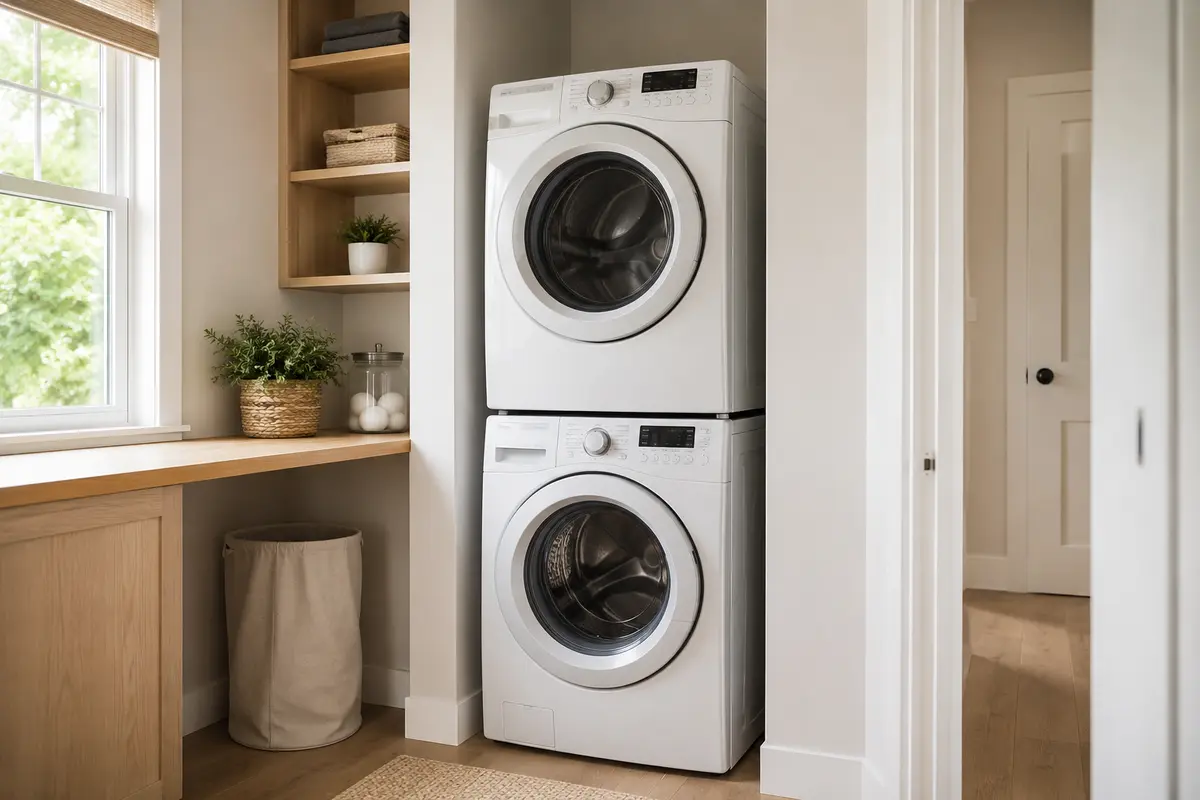
Typical stackable washer and dryer dimensions are about 27 inches wide, 77 to 80 inches tall, and 30 to 34 inches deep for a full-size stacked pair. Compact pairs are commonly about 24 inches wide, 66 to 72 inches tall, and 24 to 26 inches deep. These are planning ranges, not guaranteed dimensions. The exact size and required clearances depend on the washer, dryer, stacking kit, hookups, vent route, and installation location.
Do not compare the appliance dimensions with your empty space and stop there. A set that is 32 inches deep may need several more inches behind it for hoses or a dryer duct, plus enough room in front for both doors to open. Check the specification sheet and installation instructions for the exact models before buying.
| Configuration | Typical width | Typical stacked height | Typical appliance depth |
|---|---|---|---|
| Full-size separate pair | About 27 inches | About 77 to 80 inches | About 30 to 34 inches |
| Compact separate pair | About 24 inches | About 66 to 72 inches | About 24 to 26 inches |
| Single-unit tower or laundry center | About 24 to 27 inches in common examples | About 74 to 76 inches in common examples | About 27 to 31 inches in common examples |
Important: Add model-specific side, rear, and overhead clearances to these appliance dimensions. Also check open-door depth, closet ventilation, and the delivery path.
Standard Stackable Washer and Dryer Dimensions
A 27-inch width is the most useful starting point for a full-size stackable pair, but width alone cannot tell you whether the set will fit. Total height and installed depth are often the limiting measurements.
Manufacturer sizing guides place many full-size stacked pairs around 77 to 80 inches high and 32 to 34 inches deep. Some current front-load machines are slightly shallower. For example, the official specification sheet for the LG WM4000HWA lists the washer at 27 inches wide, 39 inches high, and 30 1/4 inches deep. Its matching dryer is designed for use with a compatible stacking kit.
This variation is why a number such as “27 x 78 x 32 inches” should be treated as an early planning estimate, not a cabinet opening or installation requirement. If you are still comparing general laundry layouts, see our complete washer and dryer dimensions guide.
Full-Size, Compact, and Single-Unit Sizes
The phrase “stackable washer and dryer” is used for several different appliance configurations. Identifying the type first prevents misleading comparisons.
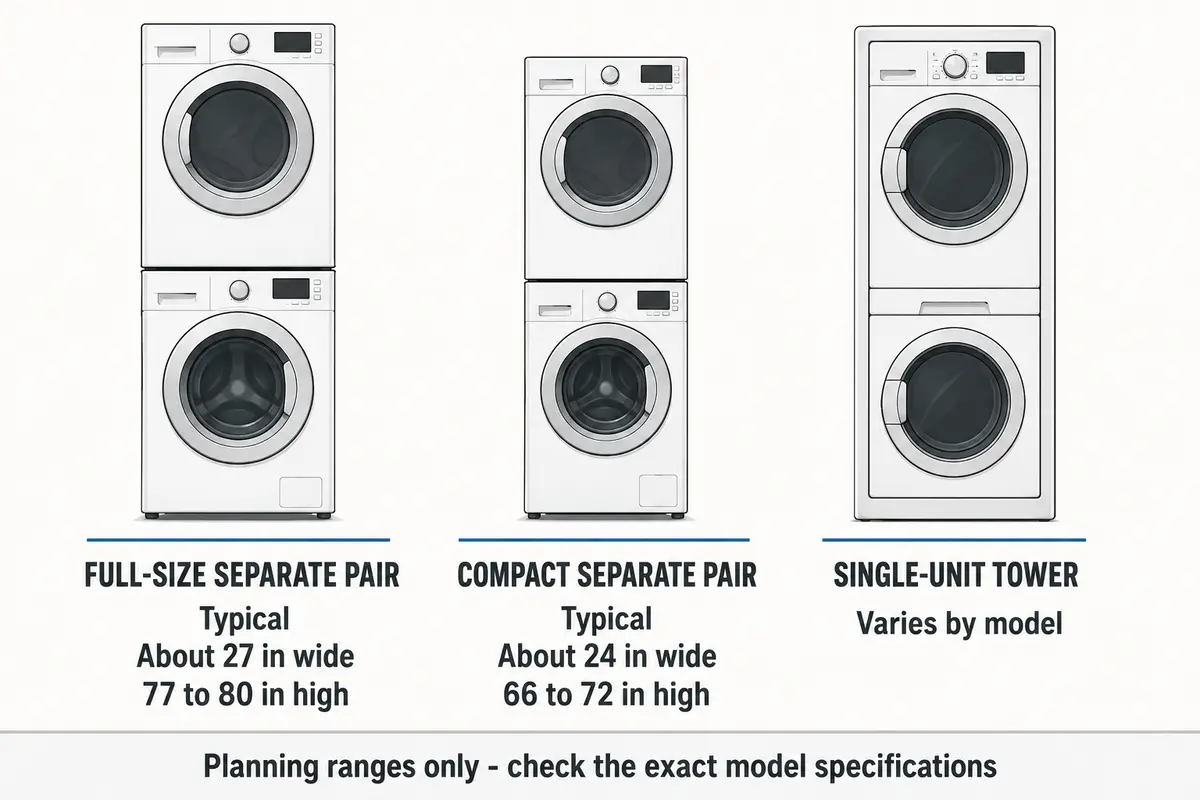
Full-size separate stackable pairs
A full-size stackable set uses two compatible front-load appliances. The washer sits on the floor, the dryer sits above it, and a manufacturer-approved stacking kit secures them together.
Many full-size pairs are approximately:
- Width: 27 inches
- Stacked height: 77 to 80 inches
- Appliance depth: 30 to 34 inches
These pairs usually provide more capacity than compact machines, but their depth can be difficult to accommodate in a shallow closet.
Compact stackable pairs
Compact separate machines are commonly built on a 24-inch-wide platform. Manufacturer guidance places many compact pairs around 66 to 72 inches high when stacked and 24 to 26 inches deep.
Compact does not automatically mean that every dimension is smaller. Controls, doors, hoses, and venting can still determine whether a particular pair works in a tight space. Some compact dryers are ventless, while others need a duct, so their installed-depth requirements can differ even when their cabinets are similar.
Single-unit towers and laundry centers
A single-unit tower or laundry center is not the same as two separate machines joined with a stacking kit. It is sold as one vertical appliance assembly.
Verified examples show the range. The LG WKE100HWA WashTower is 27 inches wide, 74 3/8 inches high, and 30 3/8 inches deep. The Whirlpool WET4024HW stacked laundry center is 23 7/8 inches wide, 74 1/4 inches high, and 26 5/8 inches deep. A larger Electrolux ELTG7600AT laundry tower is 27 inches wide, 76 1/4 inches high, and 32 inches deep.
Those examples explain why online dimension ranges sometimes seem to conflict. A 24-inch laundry center can be nearly 75 inches tall, while a compact pair from another product line may be shorter. Product type and model matter more than the label alone.
Appliance Dimensions vs. Installed Space
Product dimensions describe the appliance cabinet. Installed space must also account for the parts and movements around it.
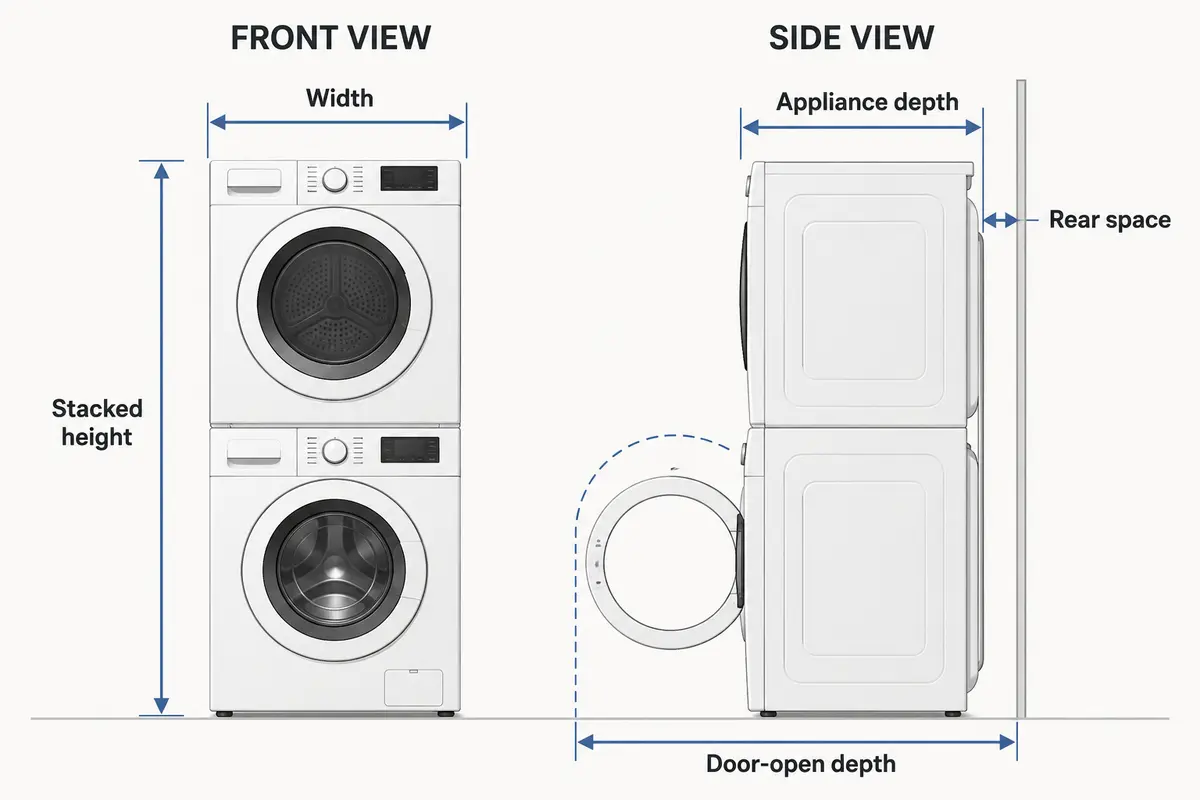
Rear space for hookups and venting
Water hoses, the drain hose, electrical connections, and a dryer duct can extend behind the machines. As broad planning guidance, Whirlpool recommends at least 5 inches behind a stacked set, while LG gives at least 4 inches at the rear in its general stacking guidance. Neither number should replace the instructions for the models you select.
A vented dryer may need more usable depth when the duct has a bulky bend or an indirect route. A compatible recessed connection or approved side-vent configuration may reduce the projection in some installations, but only use options permitted by the dryer manufacturer.
Side and top clearances
Some manufacturer planning guides use about 1 inch at each side for a closet installation. More working room can make leveling, service, and removal easier. Overhead space also matters because the dryer must be lifted into position and may eventually need to be removed.
Before choosing a tall stacked pair, confirm that the dryer controls are visible and comfortable to reach. Separate stacked pairs usually keep the dryer controls near the top, while some single-unit towers place shared controls between the washer and dryer. Control placement varies by model, so check the layout before buying.
Door-open depth
Measure forward from the back wall, not only to the front of the closed appliance. The LG WM4000HWA washer is 30 1/4 inches deep but 55 inches deep with its door open. The 24-inch Electrolux ELFE4222AW compact dryer is 24 inches deep when closed and 42 inches deep with its door open 90 degrees.
You may not need the full open-door depth inside the closet if the door opens into the room, but the appliance door must clear the closet frame, wall, room door, and nearby fixtures. You also need comfortable standing space for loading and unloading.
Closet-door ventilation
A closet is not simply a box that is slightly larger than the machines. Ventilation openings may be required in the door or enclosure, especially for a vented dryer. Fuel type and model can change the requirement. Follow the appliance installation instructions and applicable local codes rather than copying a generic louver size from another model.
How to Measure for a Stackable Washer and Dryer
- Identify the configuration. Decide whether you are measuring for a separate stackable pair, a single-unit tower, or a laundry center.
- Measure the narrowest width. Check the space at the front, middle, and back. Include trim, baseboards, hinges, pipes, and walls that are not square.
- Measure usable height. Measure from the finished floor to the lowest shelf, cabinet, ceiling obstruction, or door hardware.
- Measure available depth. Start at the wall or the point where hookups prevent the machine from moving farther back. Measure to the closet door or acceptable front projection.
- Check the open doors. Confirm that both appliance doors can open without hitting the frame, wall, or room door.
- Inspect hookups. Record the water valves, drain, outlet, gas connection if applicable, and dryer vent location.
- Measure the delivery route. Check doorways, hallways, stairs, corners, and elevator openings, not just the final laundry space.
- Compare exact documents. Use the product specification sheet for appliance size and the installation manual for clearances, ventilation, connections, and stacking-kit compatibility.
Measure twice and record every value in the same order, such as width x height x depth. This avoids accidentally comparing a product’s height with your space’s depth.
Will a Stackable Set Fit in Your Space?
Use your available dimensions to calculate the largest appliance you can consider. Do not add clearances to the appliance after choosing it. Subtract them from your available space first.
For example, suppose a laundry area has 38 inches of usable depth. If the selected model’s instructions and vent arrangement require 5 inches behind it:
38 inches available – 5 inches behind = 33 inches maximum appliance depth
A machine listed at 32 inches deep may pass that first check. It is not approved yet. You must still confirm the door can close, the appliance doors can open, the duct is not crushed, and installers can make the connections.
Apply the same method to width and height:
- Maximum appliance width = available width – required left and right clearances
- Maximum stacked height = available height – required overhead clearance
- Maximum appliance depth = available depth – required rear allowance
If any result is smaller than the manufacturer’s listed appliance dimension, the set does not fit that space as planned.
Stacking Compatibility and Installation Requirements
Two front-load machines of similar width are not automatically stackable. Confirm all three of these items before purchase:
- The washer is approved as the lower appliance.
- The dryer is approved for stacking with that washer.
- The stacking kit is specifically compatible with both model numbers.
The dryer belongs on top because the washer is heavier, especially when it contains water. The stacking kit keeps the appliances aligned and secured; placing one machine loosely on another is unsafe.
The floor must also be solid and level. A soft or uneven floor can increase movement and vibration. Follow the stacking-kit and appliance instructions, and use qualified installation help when required for lifting, gas, electrical, plumbing, or vent work.
Common Measurement Mistakes to Avoid
- Using only a typical size: A 27-inch label does not provide exact height, depth, or clearance.
- Confusing a compact pair with a laundry center: Both may be 24 inches wide but have very different heights and installation needs.
- Ignoring the dryer duct: Cabinet depth does not include every vent bend or connection.
- Forgetting open doors: A machine can fit while its washer or dryer door cannot open fully.
- Measuring only the closet opening: The interior may be narrower because of trim, valves, baseboards, or uneven walls.
- Skipping the delivery path: The set still has to pass through doors, halls, stairs, and corners.
- Assuming any stacking kit will work: Compatibility is model-specific.
- Treating planning guidance as a code requirement: Use the selected model’s installation manual and applicable local rules for the final installation.
Frequently Asked Questions
What is the standard size of a stackable washer and dryer?
A useful full-size planning estimate is about 27 inches wide, 77 to 80 inches high, and 30 to 34 inches deep. Exact dimensions vary by model, and installed space must include the required clearances and connections.
How much space is needed behind a stackable washer and dryer?
Manufacturer planning guidance commonly falls around 4 to 6 inches, but the correct amount depends on the hoses, vent type, vent route, and model instructions. Do not compress a dryer duct simply to make the unit fit.
Can a 27-inch stackable washer and dryer fit in a 28-inch opening?
Not necessarily. A nominal 27-inch machine leaves only 1 inch total, and the installation instructions may require clearance on both sides. Measure the actual product width and subtract all required side clearances from the opening before deciding.
Are all stackable washer and dryer sets the same height?
No. Full-size separate pairs, compact pairs, towers, and laundry centers can have different total heights. Even two machines with the same nominal width can differ by several inches in height or depth.
Do I add the washer and dryer heights together?
Adding the individual cabinet heights can provide an early estimate for a separate pair, but use the manufacturer’s stacked dimensions or installation documents for the final number. The stacking hardware and model design determine the completed configuration.
Bottom line: Start with approximately 27 x 77 to 80 x 30 to 34 inches for a full-size stacked pair or approximately 24 x 66 to 72 x 24 to 26 inches for a compact pair. Then verify the exact models, subtract required clearances from your available space, and check door swing, hookups, ventilation, and delivery access before buying.