
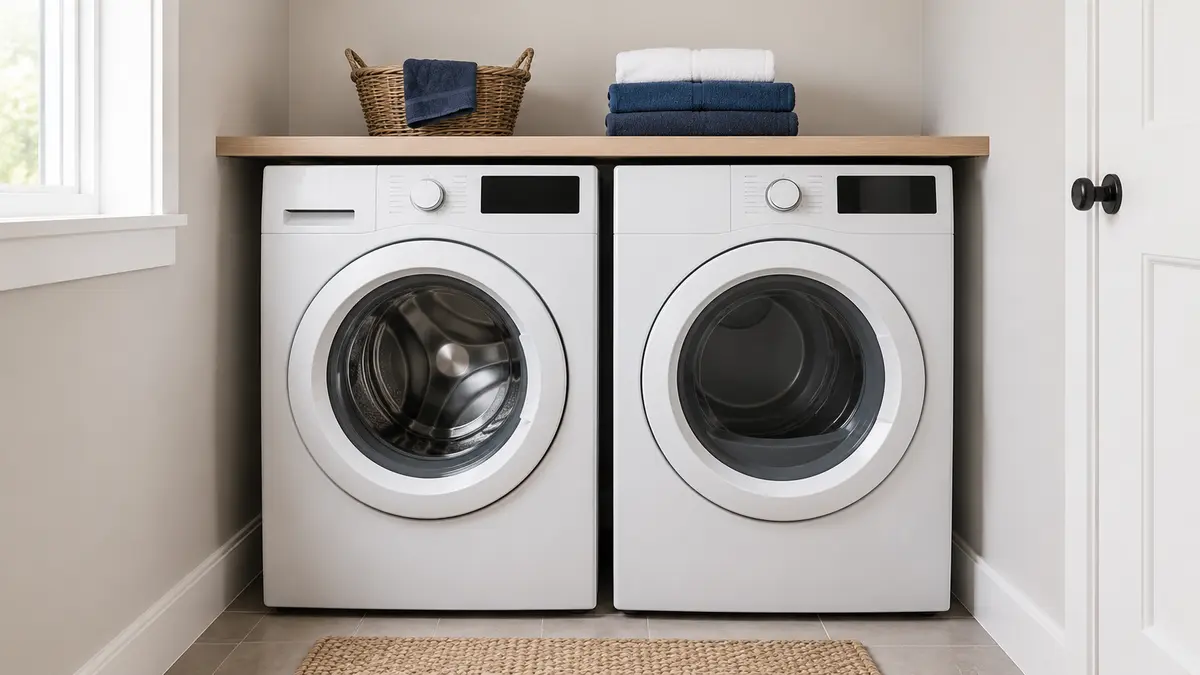
Typical washer and dryer dimensions vary by appliance type, but most full-size models are about 27 to 28 inches wide and 30 to 35 inches deep. These measurements provide a useful starting point when planning a laundry room, closet, or side-by-side installation.
Those measurements are a useful starting point, but they don’t tell the whole story. A washer that is 32 inches deep may need several more inches behind it for hoses. A dryer also needs room for its electrical or gas connection and, in many cases, an exhaust duct. You’ll need enough space to open the door or lid and move laundry comfortably, too.
For a side-by-side pair, start with the combined appliance width – usually around 54 to 56 inches – then add the clearances required for your exact models. A full-size stacked pair is commonly about 27 inches wide and 77 to 80 inches tall, although its installation opening may need to be approximately 29 inches wide.
| Washer or Dryer Type | Typical Width | Typical Height | Typical Depth |
|---|---|---|---|
| Full-size front-load washer | 27 to 28 in. | 38 to 40 in. | 30 to 35 in. |
| Full-size dryer | 27 to 29 in. | About 36 to 40 in. | 30 to 35 in. |
| Top-load washer | 27 to 28 in. | 42 to 44 in. | About 27 to 35 in. |
| Full-size stacked pair | About 27 in. | 77 to 80 in. | 32 to 34 in. |
| Compact appliance | About 24 in. | 33 to 36 in. | 24 to 26 in. |
| Single-unit laundry center | 23 to 28 in. | About 74 to 76 in. | 26 to 33 in. |
These are typical planning ranges, not universal installation requirements. Check the specification sheet and installation manual for the exact model before buying an appliance or modifying your laundry space.
Understanding the Measurements
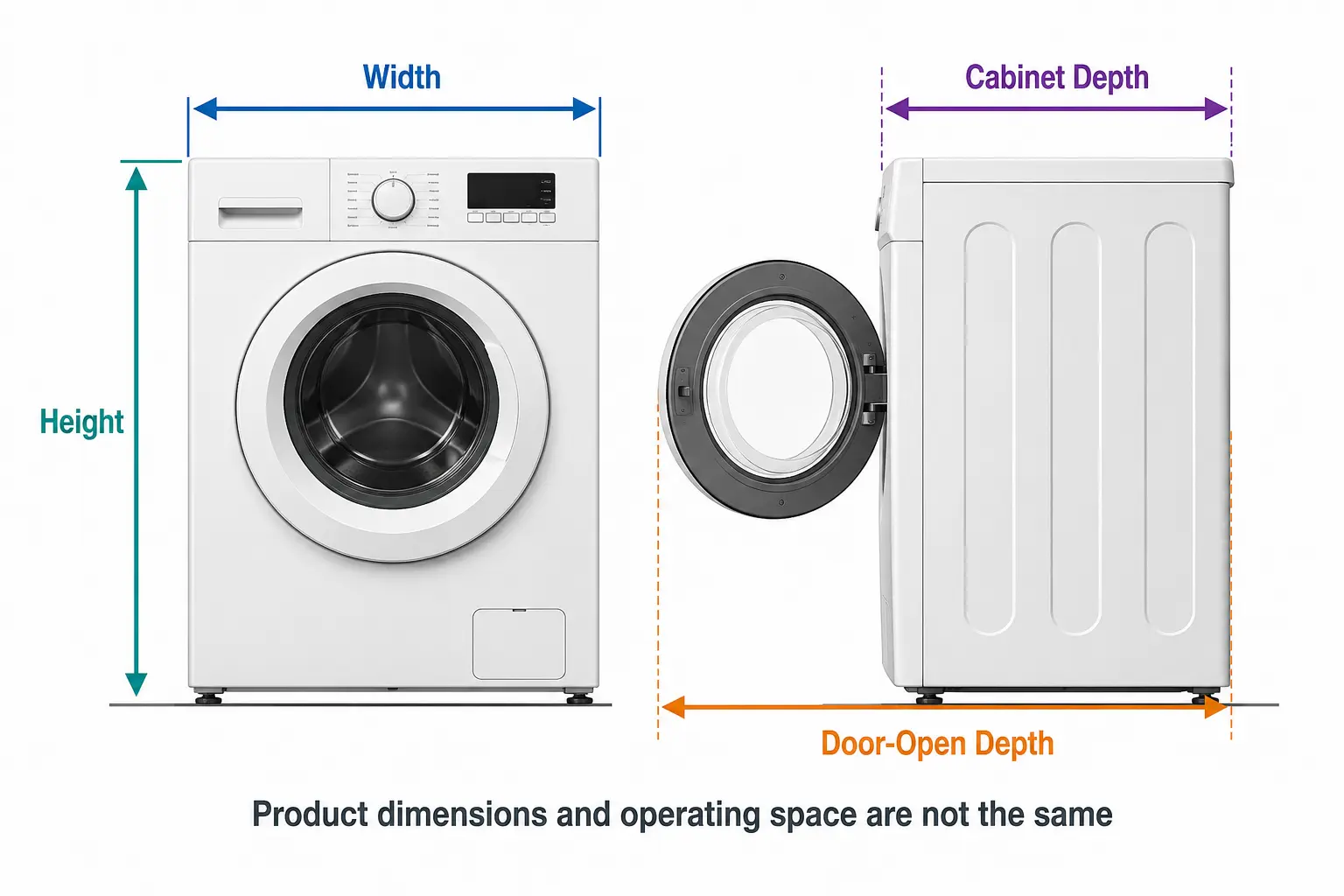
Washer and dryer measurements are normally written as width x height x depth. Width runs from side to side, height runs from the floor to the highest point, and depth runs from the front of the appliance to the back.
The tricky part is that product dimensions and space requirements aren’t the same thing. Before deciding that a machine fits, consider four different measurements:
- Cabinet dimensions: The physical width, height and depth of the appliance.
- Installed dimensions: The cabinet plus space for hoses, plugs, valves, gas connections or dryer venting.
- Operating space: The room needed to open the door or lid, load clothes and stand in front of the machine.
- Delivery path: The narrowest doorway, hallway, staircase or turn between the entrance and the laundry area.
This distinction matters most with depth. For example, the LG WM4000HWA front-load washer is 30 1/4 inches deep, but the measurement reaches 55 inches with the door open. The closed machine might fit neatly into an alcove while its open door blocks the walkway.
Washer and Dryer Dimensions by Appliance Type
The appliance style has a bigger effect on the space you need than capacity alone. Two washers with similar drum capacities can have noticeably different cabinet depths, lid heights or door-opening measurements.
Front-load washers
A full-size front-load washer is commonly 27 to 28 inches wide, about 38 to 40 inches tall and 30 to 35 inches deep. Current manufacturer specifications show how dimensions can vary within this category:
- LG WM4000HWA: 27 inches wide, 39 inches tall and 30 1/4 inches deep.
- Samsung WF45T6000: 27 inches wide, 38.7 inches tall, and 31.3 inches deep.
- GE GFW550SSNWW: 28 inches wide, 39 3/4 inches tall and 32 inches deep.
These examples aren’t shopping recommendations. They show why “standard size” is better treated as a planning range than one exact measurement.
Top-load washers
Most full-size top-load washers are around 27 to 28 inches wide and 42 to 44 inches tall. Depth varies more than many basic sizing charts suggest. Some traditional models are close to 27 inches deep, while newer large-capacity machines can extend beyond 34 inches.
Don’t forget the open lid. One Whirlpool top-load washer, for example, measures between 43 1/4 and 44 inches high when closed and 52 inches high with its lid open. A shelf that looks safely above the closed washer could still prevent the lid from opening fully.
Dryers
A full-size dryer is usually about 27 to 29 inches wide, 36 to 40 inches tall, and 30 to 35 inches deep. Matching appliances can still have different depths, so check both specification sheets instead of measuring only the dryer.
For a vented dryer, the position of the exhaust outlet affects how far the machine sits from the wall. Follow the installation instructions rather than crushing or sharply bending the exhaust duct to force the dryer into a shallow opening.
Compact appliances
Compact washers and dryers are generally about 24 inches wide, 33 to 36 inches tall and 24 to 26 inches deep. That smaller footprint can work well in an apartment, kitchen or laundry closet, but the utilities and ventilation still need to fit behind or beside the machines.
A 24-inch width also doesn’t guarantee that two compact appliances can be stacked. The washer, dryer and stacking kit must be approved for use together.
Single-unit laundry centers
A laundry center combines a washer and dryer in one tall cabinet. Depending on the model, these units are often around 23 to 28 inches wide, approximately 74 to 76 inches tall and 26 to 33 inches deep.
They can be useful where floor width is limited, although their capacity, door position and connection requirements vary. Measure the appliance as one complete unit rather than applying the dimensions of a separately stacked pair.
All-in-one washer dryers
An all-in-one machine washes and dries in the same drum. Their dimensions now vary widely. Compact models exist, but some newer high-capacity combinations are as large as conventional full-size laundry appliances.
For that reason, “all-in-one” describes the appliance function – not a guaranteed compact size. Check whether the selected machine is vented or ventless and use its exact dimensional drawing.
Side-by-Side or Stacked: How Much Room Do You Need?
Side-by-side pair
When comparing washer and dryer dimensions for a side-by-side installation, begin with the width of both appliance cabinets. If both machines are 27 inches wide, their combined cabinet width is 54 inches. Two 28-inch machines total 56 inches. That calculation doesn’t include a gap between the appliances or clearance at the walls.
Several manufacturer planning guides use approximately one inch between side-by-side machines as a starting point. The required clearance at each outer side depends on the models and the installation location.
Here is a simple planning example:
- 27-inch washer
- 27-inch dryer
- 1-inch space between them
- 1-inch planning space at each outer side
That produces a 57-inch planning width. It is an example, not a universal cutout requirement. If either installation manual specifies more space, follow the larger requirement. For additional width formulas, official model examples, and clearance guidance, see the detailed guide to side by side washer and dryer dimensions.
Stacked pair
A typical full-size stacked pair is about 27 inches wide, 77 to 80 inches tall and 32 to 34 inches deep before adding space for rear connections. Some models vary, and a practical installation opening may need to be approximately 29 inches wide.
For detailed height calculations, compact and full-size examples, and installation planning, see the complete stackable washer and dryer dimensions guide.
Stacking saves floor width, but it makes height, ceiling access and control placement more important. Measure to the lowest shelf, cabinet, pipe or ceiling obstruction – not merely to the ceiling itself.
Only stack appliances that the manufacturer identifies as a compatible pair. Use the specified stacking kit and install the dryer above the washer as directed. Similar-looking machines are not automatically safe to stack together.
Space Needed for Installation and Everyday Use
General planning guides often recommend about one inch between machines and roughly four to six inches behind them for connections and venting. These figures help estimate the space, but they don’t replace the installation instructions for the selected models.
Rear clearance changes with the appliance and connection layout. Samsung, for example, calls for at least four inches behind certain dryers, while broader planning guidance from Whirlpool and GE commonly allows about six inches behind laundry machines. Those recommendations aren’t necessarily contradictory; they cover different products and installation situations.
The manual for the exact model should always decide the final clearance.
Door and lid clearance
Front-load doors need room to swing open without hitting the other machine, a wall or the laundry-room door. If the hinge direction can’t be reversed, check the door swing before placing the order.
For a top-loader, measure vertically from the floor to the underside of the lowest shelf or cabinet. Compare that space with the manufacturer’s lid-open height – not just the closed height.
Working space in front
Leave enough room to stand with a laundry basket and open the appliance door comfortably. Four feet in front is a useful planning allowance where the room permits it, but the practical requirement depends on the layout and door swing.
In a narrow laundry area, check whether an open appliance door will block the room entrance or main walkway. A machine can technically fit and still be frustrating to use every week.
Pedestals and countertops
A pedestal can add roughly 10 to 16 inches to the height of a front-load appliance. Include it in your measurements before installing a countertop, shelf or upper cabinet.
Pedestals are model-specific, too. Matching the width is not enough; confirm that the pedestal is approved for the selected washer or dryer.
How to Measure Your Laundry Space
Use a rigid tape measure and write every dimension down. Measuring from memory – or relying on the size of the old machine – is where many fit problems begin.
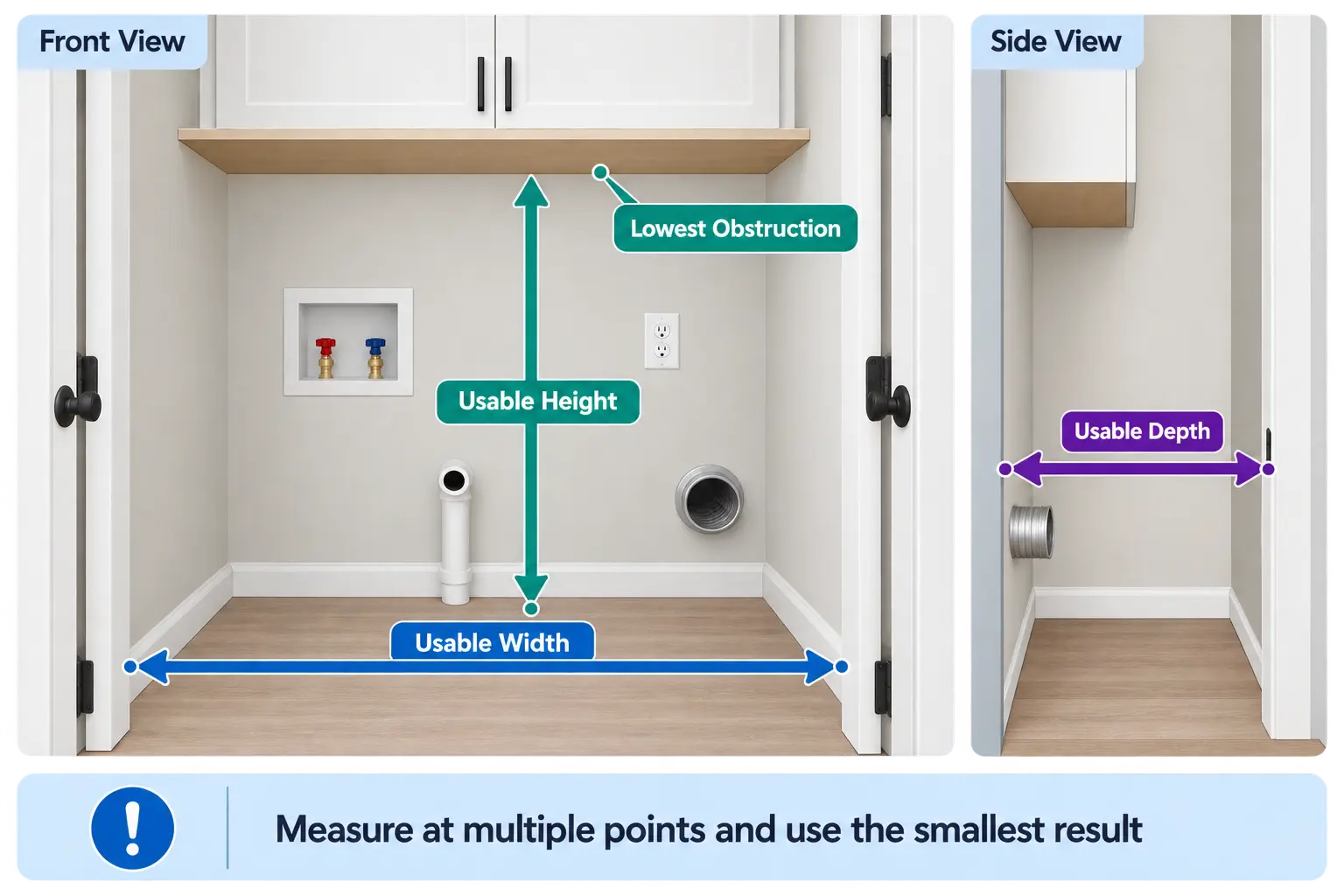
- Measure the available width. Check the opening at the front, middle and back. Record the narrowest result.
- Measure the height. Start at the finished floor and stop at the lowest shelf, cabinet, pipe or ceiling obstruction.
- Measure the depth. Measure from the back wall to the front edge of the available space.
- Locate every connection. Note where the water valves, drain, electrical outlet, gas connection and exhaust opening sit.
- Add the required clearances. Include the space specified in both appliance installation manuals.
- Check the open door or lid. Make sure it clears walls, cabinets, nearby doors and walkways.
- Measure the delivery route. Check exterior and interior doorways, halls, stairways, landings and tight corners.
Measure openings at their narrowest point. Door trim, hinges, baseboards and handrails can reduce usable width even when the main opening appears large enough.
If the appliance has to turn through a hallway, compare both its width and depth with the available turning area. Passing through the first doorway doesn’t guarantee that it can reach the laundry room.
A final check before ordering
- Confirm the exact model numbers.
- Download both specification sheets.
- Read both installation manuals.
- Compare the appliance dimensions with your smallest measurements.
- Add space for connections and ventilation.
- Confirm the door or lid movement.
- Recheck the complete delivery path.
If one measurement is close, don’t assume the appliance will squeeze into place. Ask the retailer, manufacturer or installer to confirm the requirement before ordering.
Common Questions About Washer and Dryer Fit
What is the standard width of a washer and dryer?
Many full-size washers and dryers are about 27 inches wide each, although some dryers and large-capacity models are 28 to 29 inches wide. Compact appliances are often close to 24 inches wide.
How wide should a side-by-side washer and dryer space be?
The appliance cabinets alone commonly total 54 to 56 inches. Add the required gap between the machines and any wall clearances listed in their installation manuals. Depending on the selected models, the finished opening may need to be wider than 56 inches.
How deep is a washer and dryer after installation?
Many full-size cabinets are around 30 to 35 inches deep. The installed footprint can extend several inches farther because of hoses, plugs, valves and dryer venting. Use the manufacturer’s dimensional drawing to determine the correct installed depth.
How tall is a stacked washer and dryer?
A full-size stacked pair is commonly about 77 to 80 inches tall. The complete opening must also accommodate any required top and rear clearances. Compact stacked pairs may be shorter, but their dimensions still vary by model.
Can any washer and dryer be stacked?
No. The manufacturer must identify the washer and dryer as a compatible stackable pair, and the correct stacking kit must be used. Never stack two unrelated machines based only on their dimensions.
What should I do if my measurements are very close?
Check the exact installation manual instead of relying on a general sizing range. Recheck the opening at its narrowest point, include all connections and confirm the delivery route. If there is still little margin, ask the manufacturer or installer to verify the fit before purchasing the machines.
Use typical washer and dryer dimensions only as a planning starting point. Before buying, confirm the exact width, height, depth, door or lid clearance, utility connections, and delivery path for your selected models. The manufacturer’s specification sheet and installation manual provide the final measurements needed to determine whether the appliances will fit, connect, and operate safely in your home.