
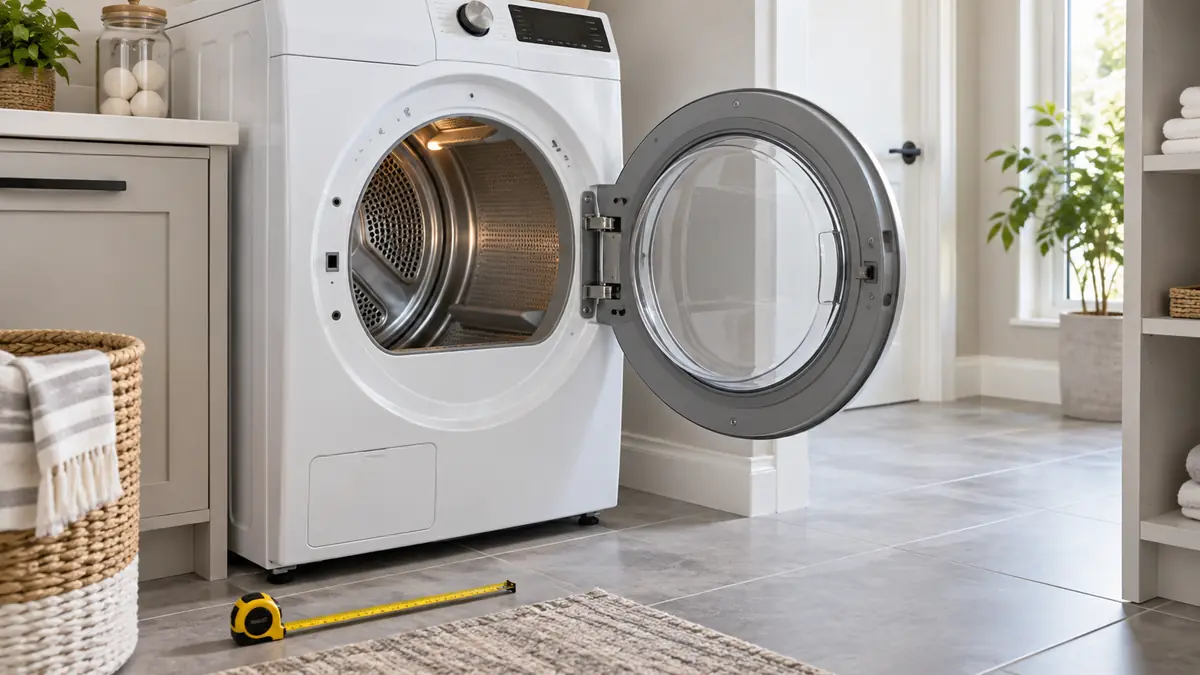
Dryer dimensions with door open vary much more than the closed cabinet depth alone suggests. Across the manufacturer examples reviewed for this guide, total depth with the door open 90 degrees ranges from about 41 11/16 inches to 59 inches. That is an example range, not a universal dryer standard. Final measurements depend on the model, cabinet depth, door size and door design.
For a tight laundry space, the number that matters most is usually the manufacturer’s “Depth With Door Open 90 Degree” or similarly named specification. It tells you how far the appliance itself reaches from its back to the outermost point of the door when opened to the stated angle. Because rear venting and installation space can increase the actual wall-to-front footprint, door-open depth should always be checked together with the dryer installation instructions.
| Dryer model | Closed depth | Depth with door open 90 degrees | Approx. added projection |
|---|---|---|---|
| Whirlpool WED5010LW | 28 3/8 inches | 41 11/16 inches | 13 5/16 inches |
| Whirlpool WED5605MW | 31 inches | 54 5/16 inches | 23 5/16 inches |
| LG DLE3400W | 30 inches | 51 inches | 21 inches |
| LG DLEX8900B | 32 1/8 inches | 59 inches | 26 7/8 inches |
| Samsung DV22K6800EW | 25 13/16 inches | 44 1/4 inches | 18 7/16 inches |
To create the added-projection column, each manufacturer’s listed closed depth was subtracted from its listed door-open depth. That comparison shows why adding one generic number to every dryer is unreliable.
Dryer Dimensions With Door Open: How Deep Is the Dryer?
No single standard exists for a dryer with its door open. Official examples above range from 41 11/16 inches for the Whirlpool WED5010LW to 59 inches for the larger LG DLEX8900B.
As a result, a number such as 50 inches should not be treated as a guaranteed fit. Even a dryer that looks fairly shallow when closed can extend much farther into the room once its door is open.
Samsung offers a useful compact example with the DV22K6800EW, which is 25 13/16 inches deep when closed and 44 1/4 inches with the door open 90 degrees. By comparison, the LG DLEX8900B is 32 1/8 inches deep when closed and reaches 59 inches with its door open.
If you are still comparing overall appliance sizes, our washer and dryer dimensions guide explains the broader width, height and depth measurements. This page stays focused specifically on dryer door-open depth.
Dryer Dimensions With Door Open vs. Closed Depth

These two measurements answer different questions.
Closed dryer depth
With the door shut, closed depth describes how deep the appliance itself is. This number helps you compare the cabinet with a closet, countertop or appliance opening.
Loading and unloading space is not included in that measurement.
Depth with the door open 90 degrees
Manufacturers usually measure door-open depth from the rear of the dryer to the farthest point of the door when it is opened to 90 degrees, according to the dimension drawing or specification.
That measurement is especially useful when the dryer faces:
- an opposite wall;
- a sink or base cabinet;
- a laundry-room door;
- another appliance;
- a storage unit;
- or a narrow passage.
A dryer can fit perfectly when closed and still be frustrating to use if the door cannot open far enough for loading and unloading.
Why Dryer Door Design Changes the Open Depth
Door construction can change the front projection by many inches, even when the closed appliance depths are fairly similar.
Whirlpool offers a particularly useful comparison. On the WED5010LW, the cabinet is 28 3/8 inches deep and the dryer uses a hamper-style drop-down door. Whirlpool lists its depth with the door open at 41 11/16 inches.
Meanwhile, the WED5605MW is only 2 5/8 inches deeper when closed, at 31 inches, yet Whirlpool lists 54 5/16 inches with its side-swing door open. During use, the difference between these two dryers becomes much larger than their closed cabinet depths suggest.
For that reason, a rule such as “add 20 inches for the door” does not work reliably. In the examples in our table, the added projection ranges from about 13 5/16 inches to 26 7/8 inches.
Side-swing doors
A side-swing door rotates outward from a vertical hinge. Projection into the room depends on the door diameter, hinge location and cabinet geometry.
Reversible doors may help with access from the left or right. Still, reversibility does not remove the need to check the documented open-depth measurement.
Hamper or drop-down doors
A hamper-style door pivots downward rather than swinging sideways. Compared with a large circular side-swing door, its projection pattern can be very different.
Even so, that does not automatically mean every hamper-door dryer is shallower when open. The Whirlpool comparison simply shows why door construction must be checked model by model.
Door-Open Depth vs. Installed Depth
One of the most important distinctions in dryer planning is that closed depth, installed depth and door-open depth are not interchangeable.
- Closed depth is the manufacturer’s cabinet depth with the door shut.
- Installed depth includes the space the dryer installation needs behind the cabinet for the applicable vent, power connection, gas connection and other model-specific requirements.
- Door-open depth is the dryer’s front-to-back appliance dimension when the door is opened to the angle stated by the manufacturer.
If the manufacturer’s door-open measurement starts at the back of the dryer cabinet, rear installation space can make the real wall-to-front footprint larger than the listed door-open number.
For example, imagine a dryer with a manufacturer-listed door-open depth of 53 inches. If the finished installation also leaves 5 inches between the back of the dryer and the wall, the open dryer could occupy about 58 inches from the wall to the front edge of the open door.
53 inches + 5 inches = about 58 inches wall-to-front
This is only a planning example. Do not automatically add 5 inches to every dryer. Use the rear installation requirement and vent arrangement for the exact model.
Our washer dryer clearance from wall guide covers rear hoses, connections and dryer vent space in detail.
How to Measure Dryer Dimensions With Door Open in Your Space

The safest way to use dryer dimensions with door open is to begin with the exact manufacturer’s specification and then reproduce that footprint in the room before buying or installing the appliance.
- Find the exact dryer model. Do not use measurements from a similar-looking dryer or from another capacity in the same product line.
- Record the closed depth. This confirms how far the cabinet itself extends.
- Find “Depth With Door Open 90 Degree.” Manufacturers may use slightly different wording, but this is the measurement you need for the open appliance footprint.
- Check the installation drawing. Identify whether additional rear room is required for venting, power or gas connections.
- Measure from the finished wall. Include baseboards or other projections if they prevent the dryer from moving fully backward.
- Mark the open-door position on the floor. Painter’s tape can make the projected front edge easy to visualize before the appliance arrives.
- Check the full door path. Confirm that the door can reach the useful opening angle without striking another object.
- Leave usable loading space. A door that technically opens may still be awkward if there is no room for you or a laundry basket in front of it.
Do not measure only from the front of the closed dryer. Instead, model the complete operating position before committing to the room layout.
Check Walls, Cabinets and Other Doors
Door-open depth is mainly a front-to-back measurement, but surrounding objects can create other conflicts.
Opposite wall
If the dryer faces a wall, compare the total open operating footprint with the distance between the appliance wall and the opposite wall. A few inches can determine whether the door opens comfortably or leaves a cramped loading position.
Cabinets and sinks
A base cabinet, utility sink or storage unit opposite the dryer can behave like a wall. Measure to the closest projecting surface rather than to the room boundary behind it.
Laundry-room door
The dryer door and room door can sometimes occupy the same floor area. Check both swing paths rather than looking only at the dryer specification.
Adjacent side wall
A side-swing dryer may also need enough room beside the hinge or handle side to open comfortably. The 90-degree depth measurement does not necessarily describe every side-clearance issue around the door.
This article does not set a universal laundry aisle width because that is a separate planning question. For whole-room dimensions, use our laundry room dimensions guide.
How to Verify Dryer Dimensions With Door Open
Your best source is the specification sheet, dimension guide or installation documentation for the exact model.
Look for terms such as:
- “Depth With Door Open 90 Degree”;
- “Product Depth with door open 90 degrees”;
- “Door-open depth”;
- or a side-view dimension drawing showing the appliance with its door open.
Whirlpool, for example, lists both ordinary depth and “Depth With Door Open 90 Degree” in its product comparison specifications. LG product pages commonly list “Product Depth with door open 90 degrees,” while Samsung specification sheets often show the open-door measurement directly in the dimension drawing.
If a retailer and the manufacturer show different measurements, use the current manufacturer documentation for the exact model unless there is a clear reason the documents refer to different versions or measurement methods.
Do not assume that two dryers with the same width or capacity have the same open depth. Even two models with nearly identical closed depths can use different doors and have very different operating footprints.
Dryer Dimensions With Door Open: Final Fit Check
- Confirm the exact dryer model number.
- Record the closed product depth.
- Record the manufacturer-listed depth with the door open 90 degrees.
- Check the rear installation and vent requirements separately.
- Measure from the finished wall, not from an imaginary cabinet position.
- Mark the open-door front edge on the floor before buying when space is tight.
- Check nearby walls, cabinets, sinks and room doors.
- Confirm that the door opens far enough for comfortable loading and unloading.
- Do not apply another dryer’s open-depth measurement to your model.
The practical answer to dryer dimensions with door open is therefore model-specific. The examples researched for this guide span from about 41 11/16 inches to 59 inches, and their added front projection varies substantially. Use the exact manufacturer’s door-open dimension, then combine it with the real rear installation space and surrounding room layout before deciding that a dryer fits.