
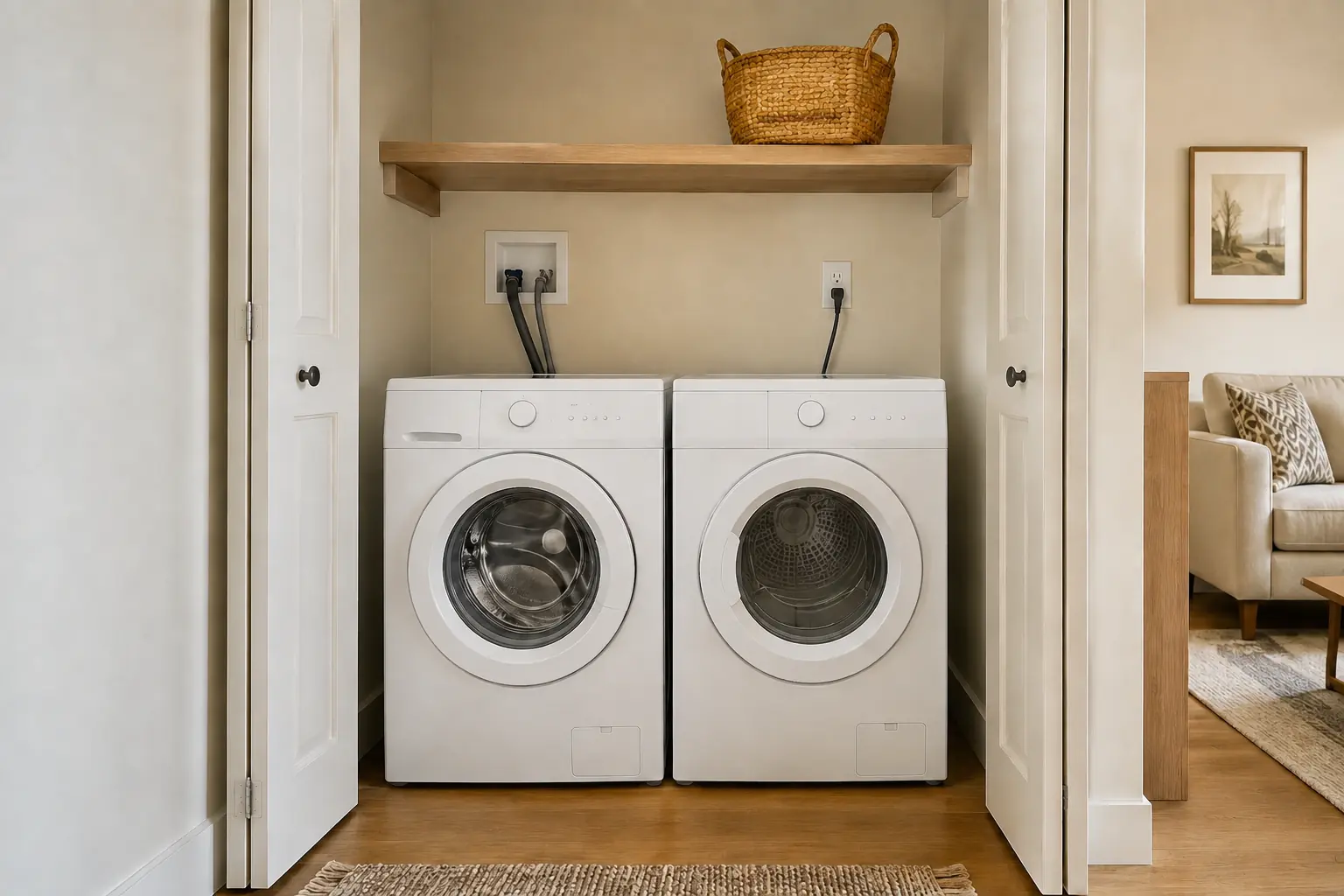
Apartment size washer and dryer dimensions are typically about 24 inches wide, 33 to 36 inches high and 24 to 26 inches deep for each compact machine. A side-by-side pair therefore needs roughly 48 inches of appliance width, while a compact stacked pair commonly occupies a footprint about 24 inches wide and 24 to 26 inches deep. Those figures are only a starting point: the real installation space must also accommodate hoses, power connections, dryer ventilation when required, door swing and the clearances specified for the exact model.
If you are trying to fit laundry appliances into an apartment closet, kitchen or narrow utility nook, measure the complete usable space rather than shopping by the “24-inch” label alone. Depth is often the measurement that causes trouble because the machine cabinet can fit while its hoses, drain line or open door cannot.
| Apartment laundry configuration | Typical appliance width | Typical appliance height | Typical appliance depth | Best use |
|---|---|---|---|---|
| Compact washer or dryer | About 24 inches each | 33 to 36 inches | 24 to 26 inches | Under a counter or in a shallow laundry area |
| Compact pair, side by side | About 48 inches combined, before clearances | 33 to 36 inches | 24 to 26 inches | A wider closet, kitchen run or laundry wall |
| Compact pair, stacked | About 24 inches | Commonly 66 to 72 inches | 24 to 26 inches | A narrow closet where vertical space is available |
| Compact all-in-one combo | Often about 24 inches | Often near counter height | Varies substantially by model | A one-machine space without room for a pair |
| One-piece laundry center | Commonly 24 to 27 inches | Often taller than a compact stacked pair | Varies by model | A narrow dedicated laundry closet |
These apartment size washer and dryer dimensions provide a useful starting point, but the exact model specifications determine whether an appliance will fit your space.
Important: The table gives planning ranges, not guaranteed installation dimensions. Always use the product specification sheet and installation manual for the exact washer and dryer you intend to buy.
Apartment Size Washer and Dryer: What the Label Means
“Apartment-size” is a useful shopping description, but it does not promise one exact set of measurements. In practice, the term usually refers to compact laundry appliances designed for small homes, condos, kitchens and laundry closets. Most compact front-load machines sold in the United States are close to 24 inches wide, compared with approximately 27 inches for many full-size appliances.
Even within the 24-inch class, height and depth change from one model to another. For example, Bosch lists its WGA12400UC compact washer at 23 1/2 inches wide, 33 1/4 inches high and 24 1/4 inches deep. Whirlpool lists the WFW3090JW compact washer at 24 inches wide, 33 1/4 inches high and 24 inches deep. These examples show why the nominal size class cannot replace an exact specification sheet.
Apartment laundry equipment can also mean several different product formats:
- Separate compact machines: A matching washer and dryer placed side by side or stacked.
- All-in-one washer-dryer combo: One cabinet that washes and dries the load.
- One-piece laundry center: A washer and dryer permanently arranged as one tall unit.
- Portable washer: A smaller machine that may connect to a sink, depending on its design and local rules.
These formats solve different space and utility problems. Do not assume that every small washer can be stacked or that every apartment can support a conventional vented dryer.
Apartment Size Washer and Dryer Dimensions
Side-by-Side Apartment Size Washer and Dryer Dimensions
A typical compact washer and dryer each measure about 24 inches wide. The two cabinets therefore account for approximately 48 inches of total width before you add any required gap between them or clearance at the walls.
Side-by-side placement gives you easier access to both controls and allows the tops to function as a folding surface when the manufacturer permits an under-counter installation. However, it requires roughly twice the floor width of stacking. Check the counter height and the appliance’s top clearance before treating 34 inches as a guaranteed opening.
Stacked Apartment Size Washer and Dryer Dimensions
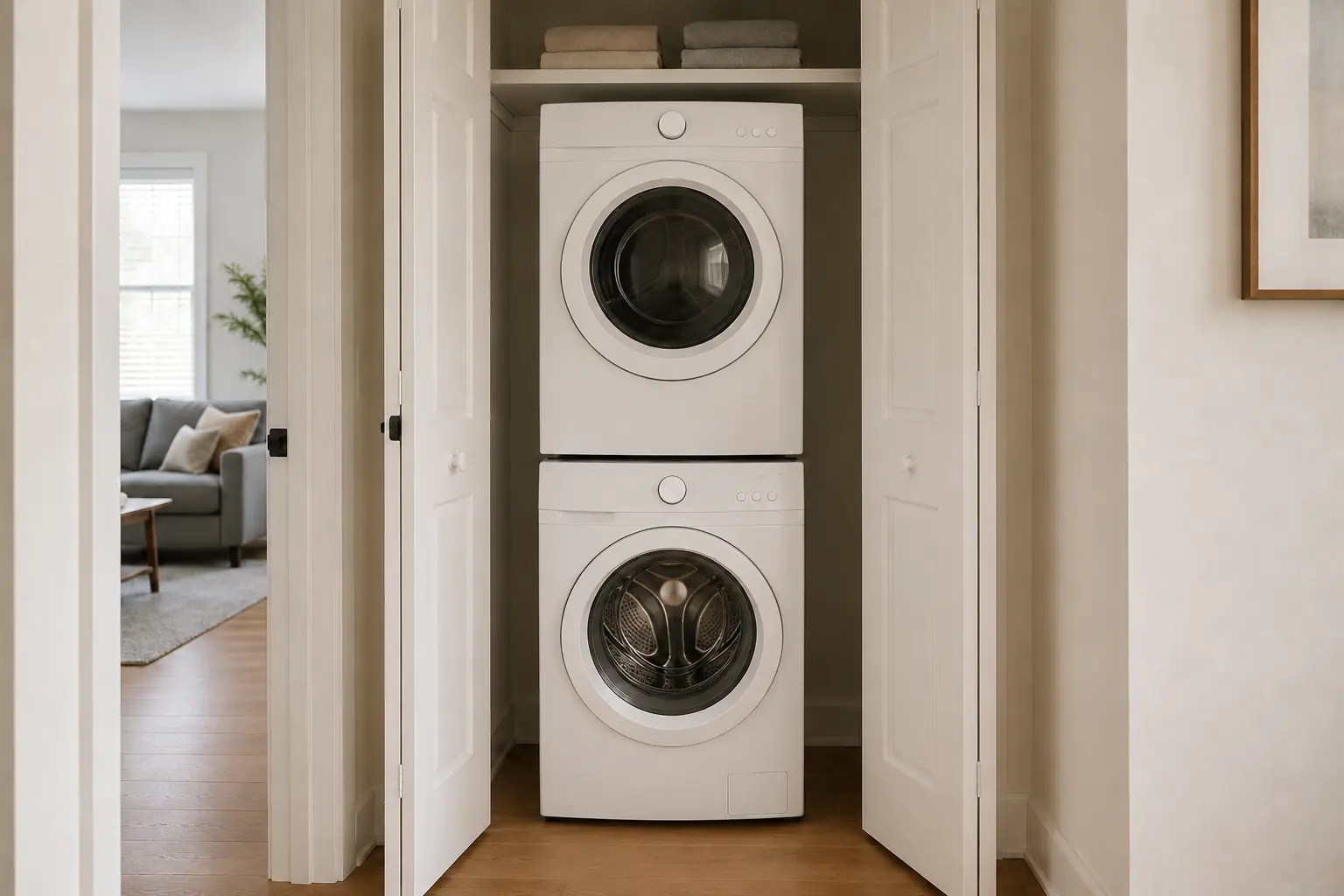
A compact stacked pair commonly measures about 24 inches wide, 66 to 72 inches high and 24 to 26 inches deep at the appliance cabinet. A current compact LG WashTower provides a useful model-specific example at 24 inches wide, 65 1/4 inches high and 26 inches deep.
A stacked setup saves floor space, but it introduces three additional checks:
- The washer and dryer must be approved for stacking together.
- The correct manufacturer-approved stacking hardware must be used.
- The ceiling, shelf and closet opening must leave the clearances required by the installation instructions.
Do not place a dryer on top of a washer simply because their cabinets have the same width. Compatibility and secure attachment matter.
All-in-One Apartment Washer and Dryer Dimensions
An all-in-one combo uses one appliance footprint instead of two. Compact examples are often approximately 24 inches wide and near counter height, but depth varies. LG, for example, lists one compact combination model at 24 inches wide, 33 1/2 inches high and 25 1/4 inches deep, with a total depth of 45 inches when its door is open.
This layout can work where a pair will not, especially when external dryer ducting is unavailable and the selected machine uses ventless drying. The tradeoff is not dimensional alone: wash-and-dry cycle time, usable capacity, electrical requirements and drainage should all be checked before choosing a combo.
Apartment Laundry Center Dimensions
A laundry center places the dryer above the washer in one connected appliance. Compact-width versions can fit a narrow closet, but they are not necessarily as shallow or as short as two compact front-load machines. Some 24-inch-class units are roughly 74 inches tall, while larger laundry centers can be 27 inches wide and more than 32 inches deep.
Use the laundry center’s complete model dimensions rather than applying the compact-pair range to it.
Apartment Size Washer and Dryer Dimensions vs. Installed Space
The listed depth usually describes the appliance cabinet or the product according to the manufacturer’s stated measurement method. It may not include all the space required for water hoses, the drain hose, plugs, a dryer duct or a fully open door.
This distinction is especially important when evaluating apartment size washer and dryer dimensions. A 25-inch-deep machine may need a noticeably deeper usable area after its connections are installed. The exact addition varies because a ventless dryer, a vented dryer and an all-in-one unit do not use identical connections.
Rear space
Whirlpool’s general compact sizing guidance recommends planning for space behind the machines for hoses and ventilation, but individual manuals may specify a different minimum. LG’s current front-load installation checklist, for example, calls for at least 4 inches between the back of a washer and the water supply in the illustrated setup. Treat all general clearance figures as early planning guidance and let the selected model’s manual control the final design.
Front working space and door swing
Front-load doors project well beyond the closed cabinet when opened. You also need room to stand, load the drum and move a laundry basket. Measure the open-door depth shown on the specification sheet, not just the closed depth.
Closet door and ventilation
A closet opening may be narrower than the interior. Door trim, hinges and folding or sliding panels can reduce usable access. Some installations also require ventilation openings in the closet door. Requirements depend on the appliance and installation instructions, so a solid unvented closet door should not automatically be assumed acceptable.
How to Measure for an Apartment Size Washer and Dryer
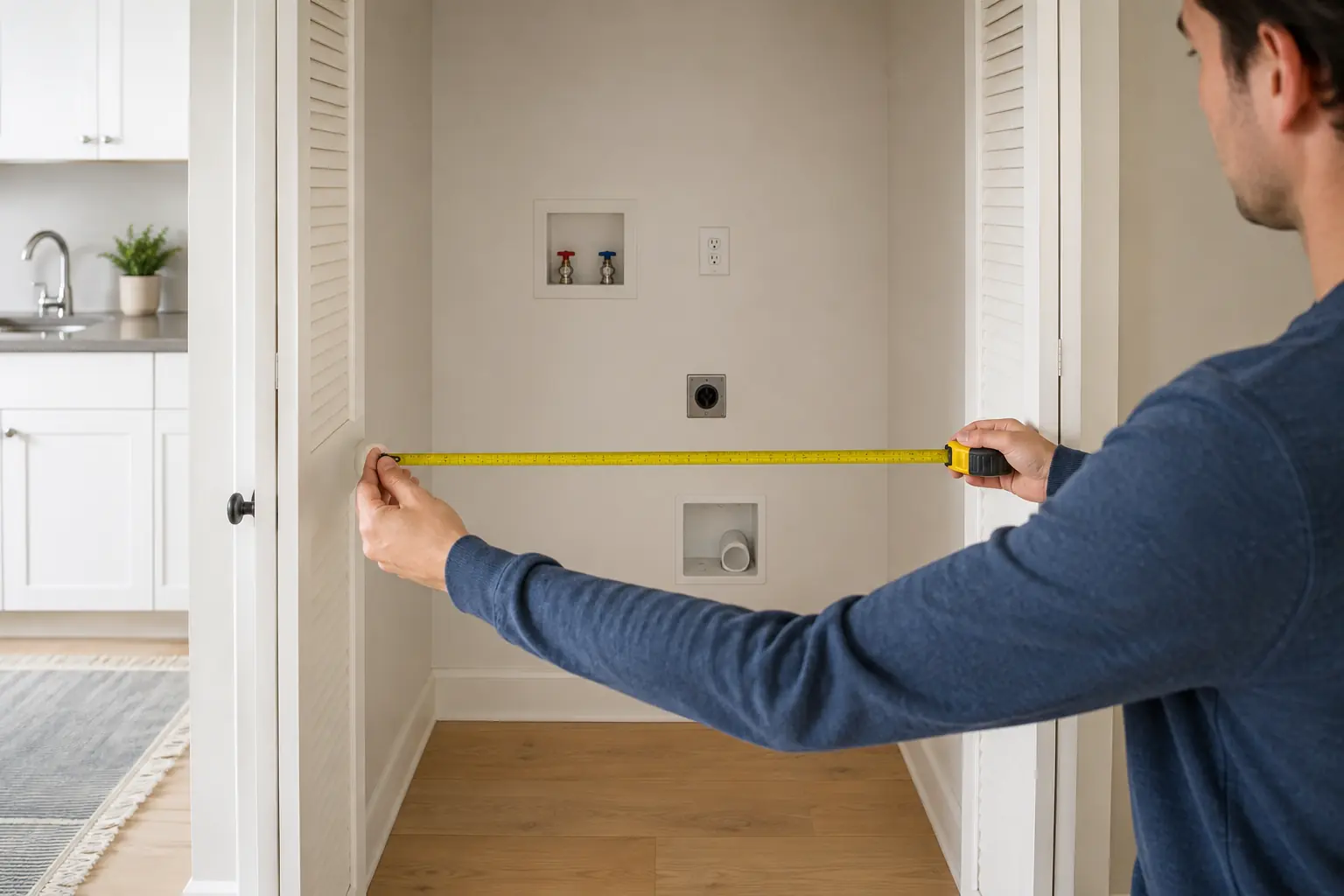
- Measure width at several points. Check the front, middle and back of the opening because walls and trim may not be perfectly square.
- Measure usable height. Include the lowest shelf, cabinet, pipe, sprinkler component or door track above the appliance.
- Measure usable depth. Measure from the back wall or the most forward connection to the point where the appliance door or closet door must close.
- Locate every connection. Record the water valves, drain, receptacle, dryer outlet and exterior vent location, if one exists.
- Check door movement. Confirm that the appliance door, closet door and nearby room door can operate without colliding.
- Measure the delivery route. Check the building entrance, elevator, apartment door, hallway, corners and the laundry-closet opening.
- Compare with the exact documents. Add only the clearances and connection space required for the chosen model and installation.
Write the measurements as width x height x depth and take photos of the space and connections. This makes it easier to compare the apartment with the manufacturer’s dimension drawing while shopping.
A practical fit calculation
Suppose an apartment closet is 27 inches wide, 75 inches high and 31 inches deep. A compact stacked pair measuring 24 inches wide, 68 inches high and 25 inches deep appears to fit by cabinet size. That is not yet a confirmed fit.
You must still verify:
- whether the remaining side and top space meets the manual;
- whether 6 inches of remaining depth is enough for the actual hoses, plug or dryer system;
- whether the appliance doors can open;
- whether the closet door provides required ventilation;
- and whether the unit can pass through the closet opening.
This calculation illustrates why subtracting cabinet dimensions is a screening step, not final installation approval.
Apartment Washer and Dryer Utilities, Venting and Permission
Physical fit is only one part of apartment compatibility. Before buying, identify what the space can actually support.
- Water supply: Confirm that compatible hot and cold connections are available if the washer requires both.
- Drainage: Verify the drain location, height and arrangement against the washer manual.
- Electrical supply: Check the required voltage, circuit and receptacle for both machines. Do not assume a compact dryer uses the same connection as the washer.
- Dryer exhaust: A vented dryer needs an approved path to the exterior. It must not exhaust into the apartment, wall cavity or attic.
- Ventless drainage: Depending on its design, a ventless dryer may collect water in a tank or drain condensed water through a hose.
- Floor: The surface must be level and capable of supporting the appliances during operation.
If you rent, obtain any required approval from the landlord or property manager before adding connections, drilling for a vent or changing cabinetry. Also check the lease and building rules. A machine that fits the closet may still be prohibited because of plumbing, electrical capacity, leak risk or building policy.
For a broader comparison of small-machine measurements, see our guide to compact washer and dryer dimensions. If you are committed to vertical placement, our stackable washer and dryer dimensions guide explains that configuration in more detail.
Apartment Washer and Dryer Fit Checklist
Before ordering, make sure you can answer yes to every applicable item:
- I have the exact model number for each appliance.
- I checked the official specification sheet and installation instructions.
- The appliance cabinet fits the width, height and depth of the location.
- The space also satisfies model-specific side, rear and top clearances.
- The appliance and closet doors can open fully.
- The machines can travel through every doorway, hallway, corner and elevator.
- The water, drain, electrical and dryer connections are compatible.
- The closet ventilation arrangement follows the installation instructions.
- The selected washer and dryer are approved to stack together, if applicable.
- The landlord, property manager or building rules permit the installation.
- An installer has confirmed any uncertain plumbing, electrical or venting condition.
For general planning, Whirlpool’s official guide to washers and dryers for apartments and small spaces compares compact, stacked, all-in-one and portable formats. Use it to understand the choices, then verify the final dimensions and requirements in the documentation for your exact model.
Frequently Asked Questions
What is the standard width of an apartment-size washer and dryer?
About 24 inches per machine is the most useful planning baseline for compact apartment laundry appliances. However, actual widths can be slightly under or over the nominal size, so check the exact specification sheet.
How wide should a closet be for a compact washer and dryer?
A side-by-side pair has approximately 48 inches of combined appliance width before required gaps and wall clearances. A stacked compact pair uses approximately 24 inches of appliance width. The correct closet width is the exact product width plus the side clearances stated in its installation instructions.
Will a 24-inch washer fit in a 24-inch opening?
Do not assume it will. “24-inch” can describe a size class rather than the exact cabinet width, and the installation may require side clearance. Measure the opening at multiple points and compare the smallest measurement with the official product drawing.
How deep should an apartment laundry closet be?
There is no universal minimum. Many compact cabinets are about 24 to 26 inches deep, but installed depth must also account for connections and any rear clearance required by the model. You must also check the appliance door and closet door.
Can any compact washer and dryer be stacked?
No. Stack only models approved as a compatible pair and use the specified stacking kit or integrated stacking system. The washer normally belongs on the bottom because it is heavier and generates movement during the spin cycle.
Is a ventless dryer automatically suitable for an apartment?
No. A ventless dryer removes the need for a conventional exhaust duct, but it still has model-specific electrical, drainage, clearance and room-condition requirements. Building permission may also be necessary.
The safest way to use apartment size washer and dryer dimensions is to treat typical ranges as a shortlist tool. Final approval should come from three matches: the exact appliance documents, the measured apartment space and the available building connections.