
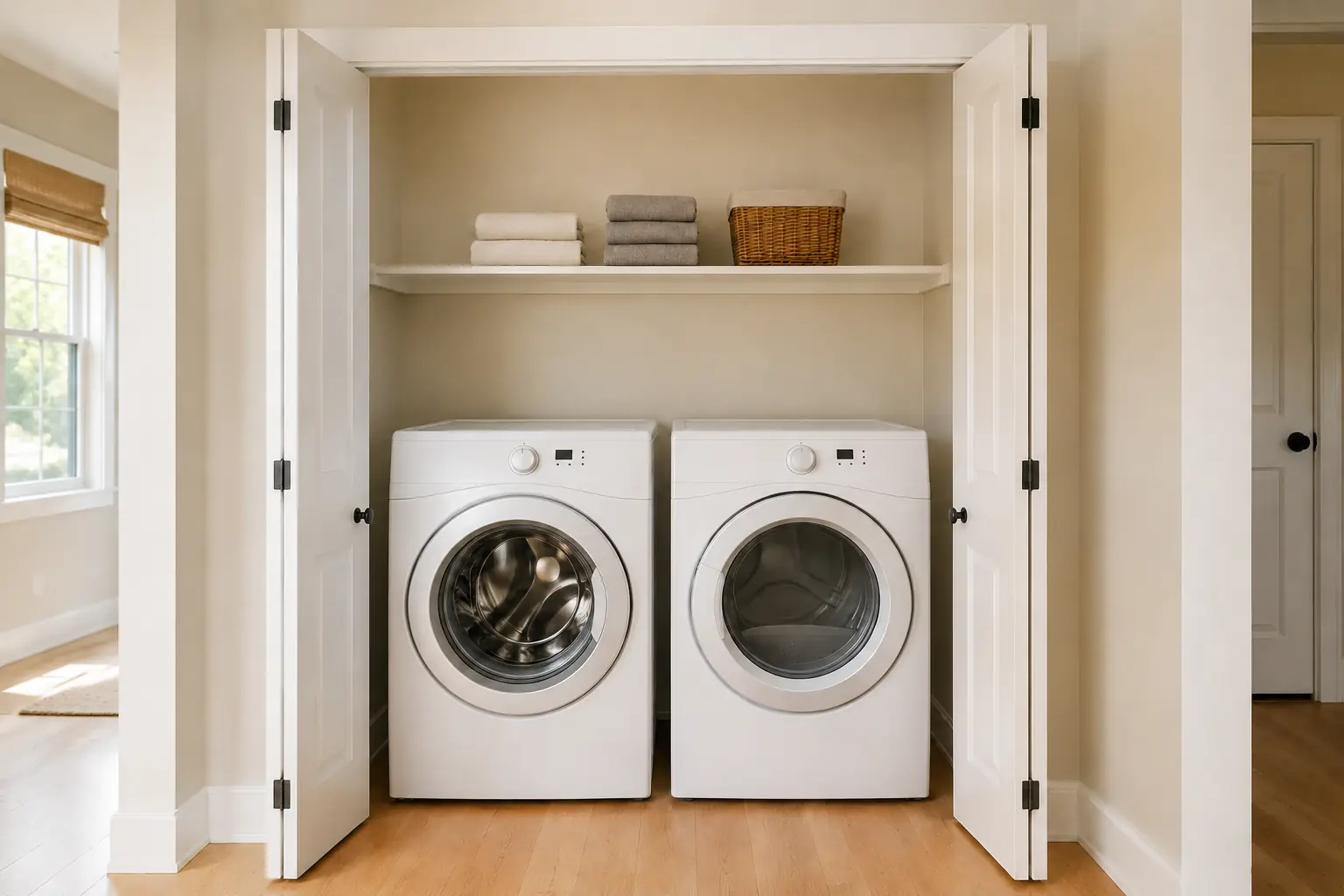
Washer and dryer closet dimensions depend on the appliance configuration, the exact model dimensions and the installation clearances in each manual. As a preliminary guide, many full-size side-by-side pairs need roughly 57 to 60 inches of usable width, while a full-size stacked pair often needs an opening around 29 to 31 inches wide. A closet depth near 36 to 40 inches works as an early planning range for many full-size installations, but it is not a universal minimum.
The correct closet size must include more than the appliance cabinets. Water hoses, a drain connection, electrical plugs, dryer ducting when required, door swing, closet-door ventilation and service access can all increase the usable space you need. Finalize the opening only after checking the specification sheet and installation instructions for the exact washer and dryer.
Quick Washer and Dryer Closet Dimensions
| Closet configuration | Preliminary usable width | Preliminary usable height | Preliminary depth | Important check |
|---|---|---|---|---|
| Full-size side by side | Often about 57 to 60 inches | Often 40 inches or more | Often about 36 to 40 inches | Add both machines and all applicable gaps |
| Full-size stacked pair | Often about 29 to 31 inches | Often about 78 to 82 inches | Often about 36 to 40 inches | Include stacking hardware and top clearance |
| Compact stacked pair | Often about 26 to 29 inches | Varies widely by matched pair | Often shallower than a full-size set | Ventless models may not need an exhaust duct |
| Top-load pair | Often in the upper 50-inch range | Must allow the washer lid to open | Depends on controls and connections | Check shelves and the closet-door track |
These are planning ranges, not building or installation requirements. A machine can fall outside them, and its manual may require different spacing. Calculate the final closet from the selected products rather than buying appliances because a generic table says they should fit.
Why There Is No Universal Washer and Dryer Closet Size
A closet that fits one laundry pair may not fit another pair with the same nominal width. A “27-inch washer,” for example, tells you its approximate width class. It does not tell you its installed depth, open-door depth, required side spacing or the shape of the connections behind it.
When comparing washer and dryer closet dimensions, begin with the exact appliance measurements and then add the applicable clearances from both installation manuals.
Five variables determine the real opening:
- Appliance dimensions: Use the width, height and depth from the official specification drawing.
- Installation clearances: Use the minimum or recommended spacing identified for a recessed or closet installation.
- Connections: Account for water valves, hoses, the drain, plugs, a gas connection when applicable and dryer ducting.
- Door movement: Check both the appliance doors and the closet doors.
- Access: Leave a realistic way to install, level, disconnect and remove the machines for service.
General manufacturer sizing guides often use approximately 27 inches wide and 32 to 34 inches deep for a standard front-load machine. Those figures are useful for early planning, but exact products vary. For a broader appliance-level comparison, see our washer and dryer dimensions guide.
Side-by-Side Washer and Dryer Closet Dimensions
A full-size side-by-side pair often needs a usable closet width in the upper 50-inch range. Two 27-inch machines total 54 inches before any gap is added. If the applicable instructions require 1 inch at the left wall, 1 inch between the machines and 1 inch at the right wall, the calculated opening would be 57 inches.
The formula is:
Required width = washer width + dryer width + left clearance + center gap + right clearance
Do not automatically insert the example clearances into every design. Read both manuals. If the washer and dryer give different spacing for their outer sides or the gap between companion appliances, use the requirements that apply to the actual arrangement.
Side-by-side width example
| Component | Example measurement |
|---|---|
| Washer width | 27 inches |
| Dryer width | 27 inches |
| Left-side allowance | 1 inch |
| Gap between machines | 1 inch |
| Right-side allowance | 1 inch |
| Example usable opening | 57 inches |
This is a worked example, not a universal minimum. A wider machine or larger manufacturer-specified clearance increases the result. Our detailed side-by-side washer and dryer dimensions guide covers appliance-width calculations more fully.
Height for front-load and top-load pairs
Front-load machines may fit below a shelf or counter when the product instructions permit it and the opening provides the required top spacing. A top-load washer needs additional vertical space for its lid. Measure the washer with the lid fully raised and check whether a shelf, door track or overhead cabinet enters that path.
Stacked Washer and Dryer Closet Dimensions
A full-size stacked pair commonly starts with a 27-inch-wide appliance footprint. General planning guidance often produces a closet opening around 29 to 31 inches wide and approximately 78 to 82 inches high. Compact 24-inch pairs can fit narrower openings, but their installed height and required clearances still vary.
Whirlpool’s general sizing guidance uses approximately 29 inches wide and 80 inches high as a planning area for some stacked setups. That is useful for a shortlist, not permission to frame every closet to those measurements. A particular pair may be taller, deeper or require more space at the top, sides or rear.
Stack only compatible machines
A washer and dryer should be stacked only when the manufacturers identify them as compatible and specify the appropriate stacking kit or integrated system. The washer belongs at the bottom. Do not treat two equal cabinet widths as evidence that the machines can be safely stacked.
For model types, height ranges and compatibility considerations, use the separate stackable washer and dryer dimensions guide.
Make the controls usable
Before approving the closet height, check the location of the upper controls. The appliances may fit physically while leaving dryer controls difficult to see or reach. Also confirm that any shelf above the stack does not block installation, service or required airflow.
How to Calculate Washer and Dryer Closet Depth
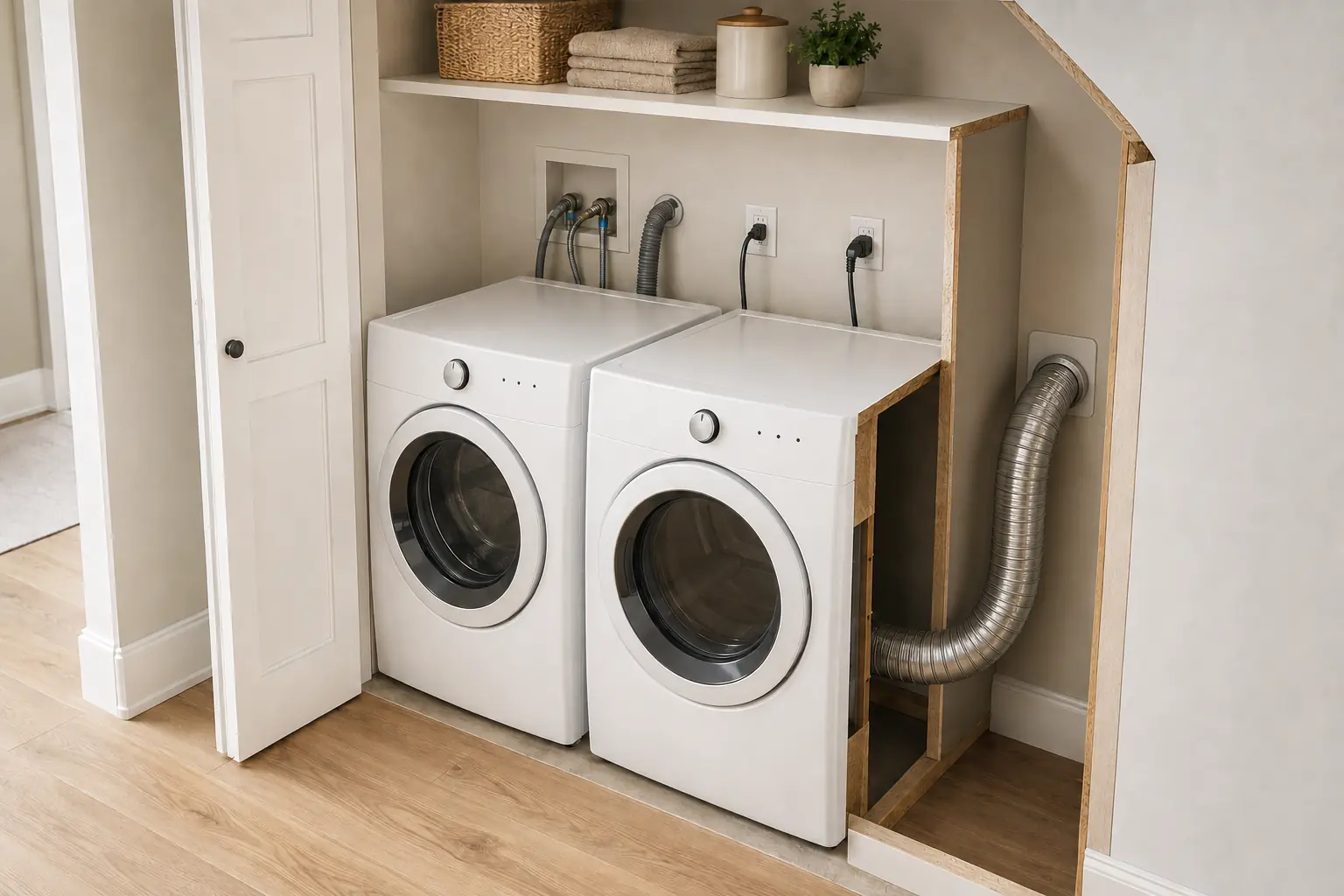
Depth is often the dimension that causes a failed installation. Product depth and installed depth are not always the same measurement. The machine may fit inside the empty closet but project beyond the trim after its hoses, plug and dryer duct are connected.
Use this method:
Required closet depth = deepest appliance dimension + actual rear connection space + any required front clearance inside the closed closet
Start with the deeper machine. Then inspect the connection layout rather than adding one generic number. A conventional vented dryer may need space for an exhaust elbow and duct. A compact ventless dryer may not need exterior ducting, although it still has electrical, drainage and airflow requirements.
Closed depth and open-door depth solve different problems
The closed installed depth tells you whether the closet door can close without pressing on the appliance or connections. Open-door depth tells you whether the appliance door can swing fully and whether you can load it from the hallway or room.
The working area in front does not always have to be inside the closet. It may extend into the hallway or laundry room while the closet is open. Still, it must remain usable and should not create an unsafe conflict with another door or narrow passage.
Do not crush the dryer duct
A shallow closet should not be made to work by compressing or sharply kinking a dryer duct. Follow the dryer installation instructions for duct material, diameter, routing and maximum length. LG’s official dryer venting guidance, for example, warns against kinked, crushed or dented ductwork and recommends keeping the route short and direct.
Closet Doors, Ventilation and Appliance Access
Three separate issues are often grouped under the word “ventilation”:
- Dryer exhaust: A vented dryer sends exhaust through an approved duct to the exterior.
- Closet air openings: Some appliance instructions require openings in a closet or cabinet door.
- Clearance around the appliance: Space may be required for airflow, vibration, connections or service.
Meeting one condition does not automatically satisfy the others. A louvered door does not replace a required dryer exhaust duct, and a ventless dryer is not automatically approved for a sealed closet.
Closet-door openings are model-specific
Some dryer manuals show a 48-square-inch upper opening and a 24-square-inch lower opening as required closet-door ventilation for that model. Those numbers are common in appliance documentation, but they are not a universal rule for every washer, dryer or laundry center. Follow the installation instructions for the selected product and any applicable local requirements.
Measure the actual doorway
The clear doorway can be smaller than the closet interior. Bifold panels, hinges, knobs, tracks, jambs and trim can reduce the opening. Measure the narrowest usable width with the door fully open, then compare it with the appliance and packaged delivery dimensions.
The doors also need to close without touching machine controls or pressing against a front-load door. If the appliances project beyond the opening, verify that this is intentional, safe and compatible with the surrounding passage.
How to Measure a Washer and Dryer Closet
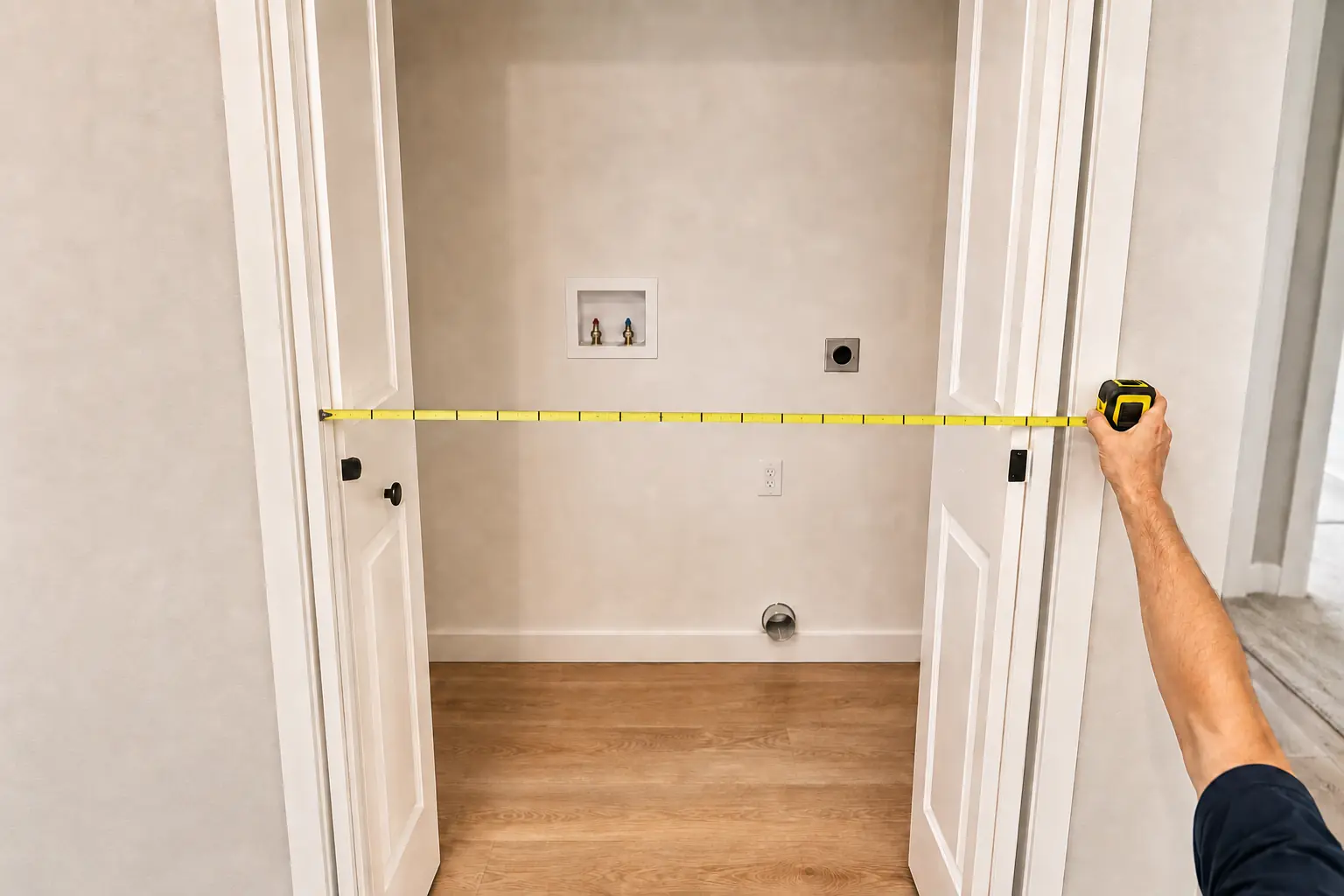
- Measure inside width. Check near the floor, at appliance height and near the top because walls may not be square.
- Measure clear doorway width. Record the narrowest point between doors, hinges and trim.
- Measure usable height. Stop at the lowest shelf, track, cabinet, pipe or other obstruction.
- Measure depth. Identify the back wall and the most forward water valve, drain box, outlet or vent connection.
- Map the hookups. Photograph and record water, drainage, electricity, gas when applicable and the dryer exhaust location.
- Check door movement. Test the closet doors and estimate the washer or dryer door path from the model drawing.
- Walk the delivery route. Measure the entrance, stairs, elevator, hallway, turns and the laundry opening.
- Compare exact documents. Use the specification sheet and recessed-or-closet installation diagram for each appliance.
Do not rely on a single measurement from the center of the closet. Base the fit on the smallest usable dimension and include molding, baseboards and protruding connections.
Washer and Dryer Closet Fit Worksheet
Complete this worksheet before ordering the machines. Tap each field to enter your measurements; entries may clear when the page is refreshed:
| Fit item | Closet measurement | Appliance plus required space | Pass or review |
|---|---|---|---|
| Usable width | |||
| Usable height | |||
| Closed installed depth | |||
| Clear doorway width | |||
| Open-door working depth | |||
| Closet-door ventilation |
A pass means the closet equals or exceeds the applicable product requirement. It does not mean every installation condition has been approved. Confirm the utilities, floor, dryer exhaust and any local permit or building requirements with the appropriate installer or authority.
Final fit checklist
- The exact model numbers are known.
- Both specification sheets and installation manuals were checked.
- The cabinet and required spacing fit the smallest closet measurements.
- The rear connections will not be crushed or kinked.
- The appliances can pass through the doorway and delivery route.
- The closet and appliance doors can operate fully.
- Top-loader lid clearance or stacked-unit height has been verified.
- The selected pair is approved for stacking when applicable.
- Closet-door air openings match the model instructions.
- The machines can be accessed and removed for service.
Frequently Asked Questions
What is a standard washer and dryer closet size?
There is no universal standard. A full-size side-by-side closet often begins around 57 to 60 inches of usable width, while a stacked full-size setup often begins around 29 to 31 inches wide. Depth near 36 to 40 inches is a useful early planning range for many full-size installations. Verify all three dimensions against the exact models and connections.
Is a 36-inch-deep closet enough for a washer and dryer?
It may be enough for some models and connection layouts, but 36 inches does not guarantee a fit. Compare the deepest appliance with its required rear spacing, the actual position of the hoses or duct and the space needed for the closet door to close.
How wide should a closet be for two 27-inch machines?
The cabinets total 54 inches. Add the applicable left, center and right spacing from the installation documents. If those spaces total 3 inches, the example opening becomes 57 inches. Different products may produce a different result.
How big should a closet be for a stackable washer and dryer?
Many full-size stacked pairs can be screened using an opening around 29 to 31 inches wide and approximately 78 to 82 inches high, plus the depth needed for the appliance and connections. Compact pairs may be narrower and shorter. The matching-pair documents determine the final dimensions.
Does a washer and dryer closet need louvered doors?
Not every installation specifically requires a louvered door, but some manuals require upper and lower ventilation openings or an equivalent louvered opening. A solid door is acceptable only when the appliance instructions and applicable requirements allow that arrangement.
Can a ventless dryer go in a closed closet?
Ventless means the dryer does not use a conventional exterior exhaust duct. It does not mean the machine has no clearance, airflow, electrical, drainage or room-condition requirements. Check the exact model instructions before placing it behind a closed door.
Use typical washer and dryer closet dimensions to decide which configurations deserve a closer look. Use the exact appliance documents, measured opening and connection layout to decide what actually fits.