
Laundry tower dimensions vary by design and model, but many full-size integrated front-load towers are roughly 27 to 28 inches wide, 74 to 77 inches high, and 30 to 33 inches deep. Compact towers can be much smaller. A current Whirlpool compact tower, for example, is about 23.6 inches wide, 63.7 inches high, and 26.8 inches deep.
Those numbers are useful for early planning, not for final installation. The product cabinet is only one part of the fit. Door swing, hoses, a drain connection, power, dryer venting when required, and manufacturer-specified installation space can all increase the room you actually need. Always check the specification sheet and installation instructions for the exact model before ordering or building around it.
| Laundry configuration | Width | Height | Depth | What the numbers mean |
|---|---|---|---|---|
| Full-size integrated front-load tower | About 27 to 27 3/4 in. | About 74 3/8 to 76 7/8 in. | About 30 3/8 to 32 3/8 in. | Range across the verified full-size examples in this guide, not a universal standard |
| Compact integrated tower | About 23.6 in. | About 63.7 in. | About 26.8 in. | Current Whirlpool WFH5424SJ example |
| Traditional top-load laundry center | 23 7/8 in. | 74 1/4 in. | 26 5/8 in. | Whirlpool WET4024HW example |
The table deliberately separates product types. A single integrated tower is not the same thing as two independent appliances joined with a stacking kit, even though both place the dryer above the washer.
What Counts as a Laundry Tower?
For this guide, a laundry tower means a washer and dryer designed and sold as one integrated vertical appliance. The washer is normally below the dryer, with the two sections built into a coordinated single-unit design.
That definition includes modern front-load laundry towers as well as traditional single-unit laundry centers. It does not include two separate front-load appliances that are stacked later with a manufacturer-approved stacking kit. Those are covered separately in our stackable washer and dryer dimensions guide.
It also does not mean a single-drum all-in-one washer-dryer combo. An all-in-one combo washes and dries in the same drum, while a laundry tower has separate washer and dryer sections arranged vertically.
Typical Laundry Tower Dimensions
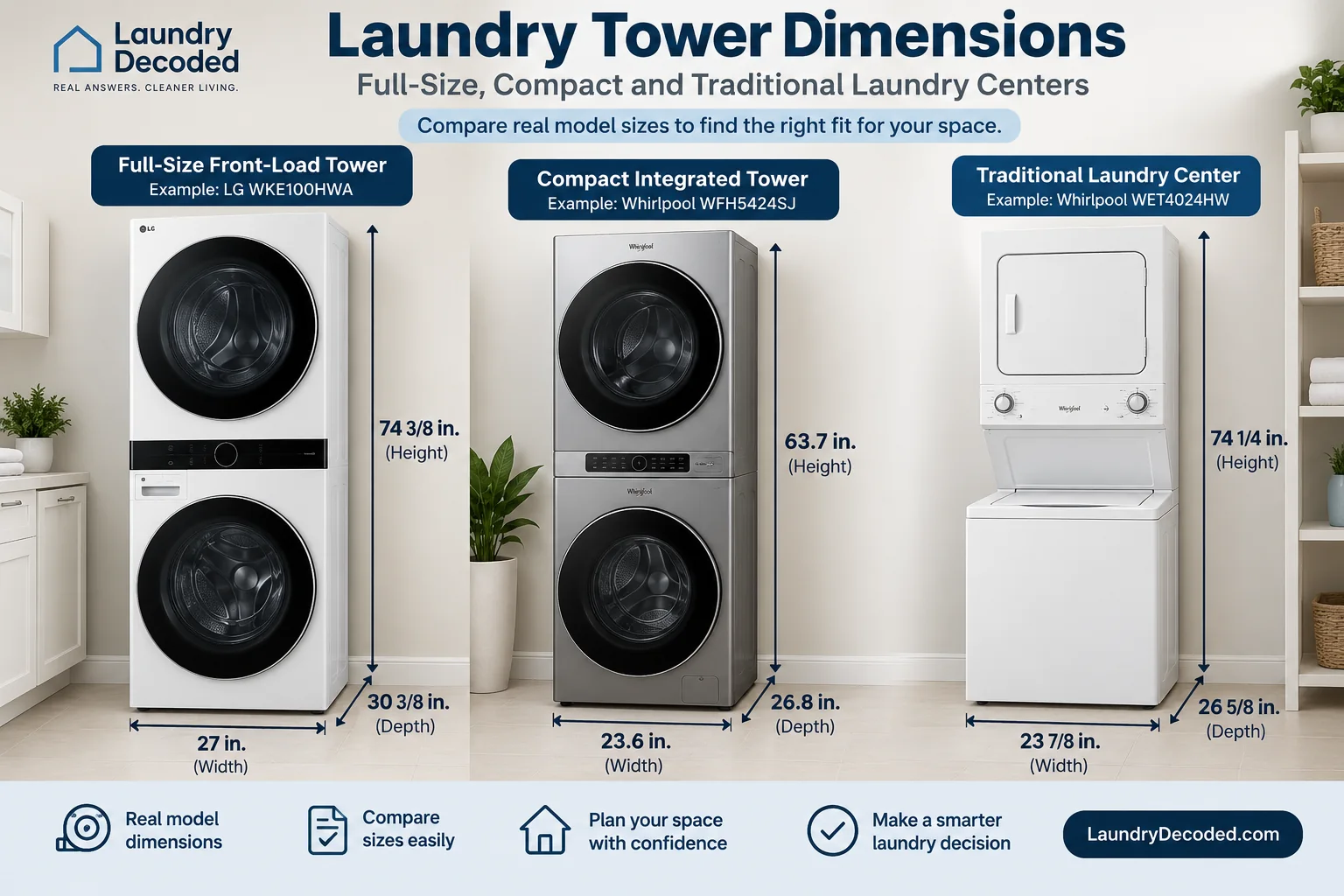
There is no single standard set of laundry tower dimensions. Current products include compact ventless towers, full-size front-load towers, and traditional top-load laundry centers, so the overall height and depth can differ significantly.
Full-Size Front-Load Towers
Among the full-size integrated examples verified for this guide, width is close to 27 inches, height is roughly 74 to 77 inches, and cabinet depth is roughly 30 to 33 inches. For example, the LG WKE100HWA is 27 inches wide, 74 3/8 inches high, and 30 3/8 inches deep, while the Electrolux ELTE7600 series is 27 inches wide, 76 1/4 inches high, and 32 inches deep.
A current Whirlpool WEF5727TW is slightly wider and taller at 27 3/4 inches wide, 76 7/8 inches high, and 32 3/8 inches deep. These examples show why planning around a generic “27-inch tower” can still create a fit problem if the available height or depth is tight.
Compact Integrated Towers
Compact towers can reduce all three dimensions, not just width. Whirlpool lists its WFH5424SJ compact ventless heat-pump tower at approximately 23.6 inches wide, 63.7 inches high, and 26.8 inches deep.
If you are comparing that type of appliance with separate 24-inch machines, see our compact washer and dryer dimensions guide. The compact article covers independent compact washers and dryers, while this page stays focused on integrated towers.
Traditional Laundry Centers
A traditional laundry center is also an integrated vertical appliance, but it often uses a top-load washer below an upper dryer. These products can be narrower and shallower than some modern full-size front-load towers.
For example, Whirlpool lists the WET4024HW laundry center at 23 7/8 inches wide, 74 1/4 inches high, and 26 5/8 inches deep. That is a useful reminder that the word “tower” does not describe one fixed cabinet size or one washer-door style.
Verified Laundry Tower Dimensions by Model
The safest way to compare towers is with model-specific dimensions from current manufacturer documentation. The examples below are intended to show real variation, not to define universal minimums or maximums.
| Model | Type | Width | Height | Product depth | Additional depth information |
|---|---|---|---|---|---|
| LG WKE100HWA | Full-size front-load WashTower | 27 in. | 74 3/8 in. | 30 3/8 in. | 55 in. with door open |
| Electrolux ELTE7600AT / ELTE7600AW | Full-size front-load laundry tower | 27 in. | 76 1/4 in. | 32 in. | 36 in. minimum installation depth |
| Whirlpool WEF5727TW | Full-size front-load laundry tower | 27 3/4 in. | 76 7/8 in. | 32 3/8 in. | Whirlpool describes it as designed for a 33 in. installation depth |
| Whirlpool WFH5424SJ | Compact ventless heat-pump tower | 23.62 in. | 63.7 in. | 26.77 in. | Compact integrated example; verify current installation instructions |
| Whirlpool WET4024HW | Traditional top-load laundry center | 23 7/8 in. | 74 1/4 in. | 26 5/8 in. | Check the current model documentation for door-open clearance |
LG’s official WKE100HWA specifications list the product at 27 x 74 3/8 x 30 3/8 inches and give a 55-inch depth with the door open. Electrolux’s ELTE7600 specification sheet lists a 32-inch product depth but a 36-inch minimum depth for installation.
Whirlpool’s current product information also shows how broad this category has become. The company sells both the full-size WEF5727TW front-load tower and the much smaller WFH5424SJ compact ventless tower. The exact model matters more than the category name alone.
Product Depth Is Not the Same as Installed Depth
Depth is one of the easiest measurements to underestimate. A manufacturer may list the cabinet or product depth, but the installed appliance can require additional room behind it for connections or for a specified installation space.
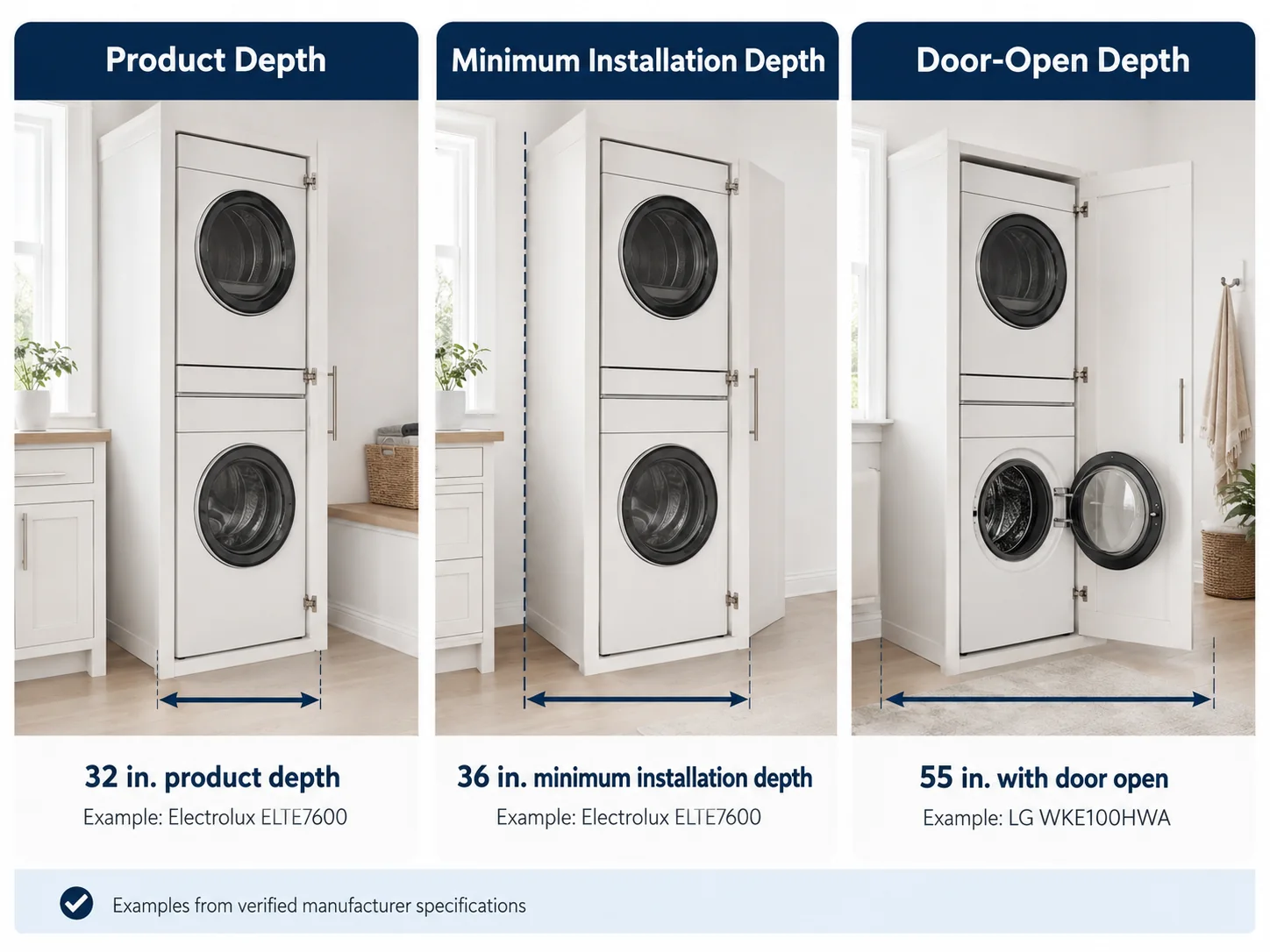
The Electrolux ELTE7600 is a clear example. Its product depth is 32 inches, while its official specification sheet lists a 36-inch minimum depth for installation. That means a 32-inch-deep opening should not be assumed to fit simply because the cabinet itself is 32 inches deep.
The same principle applies to other towers, but the amount of extra space is model-specific. A vented dryer may need room for its exhaust connection, while a ventless tower has a different rear setup. Water hoses, the drain hose, plugs or cords, wall fittings, and service access can also affect the final position.
Do not automatically add a generic rear-clearance number to every model. Use the exact installation instructions. If the tower will go inside a closet, our washer and dryer closet dimensions guide covers the opening itself, doors, hookups, and other closet-level planning without turning this appliance-size guide into a second closet article.
Door-Open Depth Can Be Much Greater
A tower can fit when closed and still be awkward to use. Front doors need space to swing open, and the open door can add a large amount to the total front-to-back footprint.
LG lists the WKE100HWA at 30 3/8 inches deep when closed and 55 inches deep with the door open. That is an increase of 24 5/8 inches. Other towers can use different door geometry, so check the current dimension drawing rather than assuming the same added depth.
Door-open depth matters most when the tower faces a wall, hallway, island, sink cabinet, or another door. Measure the usable space in front of the appliance, not just the empty recess behind it.
Also check which door or doors reverse on the exact model. A reversible door may help with circulation, but do not assume reversibility unless the product documentation confirms it.
How to Measure for a Laundry Tower
Start with the appliance model, then measure the installation area around that model. This keeps the process from turning a rough planning range into a false minimum.
- Measure the usable width. Measure between finished walls, trim, cabinets, door hardware, or other fixed obstructions. Use the narrowest point.
- Measure the usable height. Check the floor-to-ceiling or floor-to-shelf distance, including any overhead track, cabinet, trim, or sloped ceiling that reduces the opening.
- Measure the usable depth. Measure from the back installation plane to the point where the tower can project without blocking a door, hallway, or other feature.
- Locate every connection. Note the water supply, drain, electrical connection, gas connection if applicable, and dryer exhaust if the model is vented.
- Check manufacturer installation space. Product dimensions alone do not tell you the required rear, side, top, or closet spacing.
- Check door-open depth. Confirm that washer and dryer doors can open far enough for normal loading and unloading.
- Check the delivery path. Measure doors, hallways, stairs, turns, and other narrow points before purchase. The installed opening can be large enough even when the appliance cannot physically reach it.
When your measurements are close to the published dimensions, do not round the appliance down or the opening up. Use the actual specification drawing and installation instructions, and allow for construction tolerances or uneven walls where relevant.
Laundry Tower vs Stackable Washer and Dryer Dimensions
The biggest difference is not simply height. A laundry tower is engineered as an integrated unit, while a stackable pair begins as two compatible independent appliances that are joined using an approved stacking system.
| Feature | Integrated laundry tower | Separate stackable pair |
|---|---|---|
| Construction | Designed and sold as one coordinated vertical appliance | Two separate compatible appliances |
| Width planning | Use the tower’s single published product width | Use the dimensions of the compatible stacked appliances and approved configuration |
| Height planning | Use the manufacturer’s complete tower height | Depends on both appliance heights and the approved stacked configuration |
| Controls | Often positioned near the center on modern front-load towers | Dryer controls may remain near the top unless the model has another control arrangement |
| Replacement flexibility | Integrated design ties the washer and dryer sections together as one product system | Separate appliances may offer more individual replacement flexibility, subject to compatibility |
Do not use dimensions from a separate stacked pair to size an integrated tower, or vice versa. Even when both are roughly 27 inches wide, their total height, depth, controls, connections, and required installation space can differ.
Frequently Asked Questions
What are standard laundry tower dimensions?
There is no universal standard. Many current full-size integrated front-load examples are about 27 to 28 inches wide, 74 to 77 inches high, and 30 to 33 inches deep, while compact towers can be substantially smaller. Use those figures for early planning only and verify the exact model before purchase.
Are all laundry towers 27 inches wide?
No. Several full-size examples are close to 27 inches wide, but compact and traditional laundry centers can be narrower, and some full-size models are wider than exactly 27 inches.
How deep should the space be for a laundry tower?
There is no single depth that fits every tower. Start with the model’s product depth, then follow its installation instructions for connections and required spacing. For example, the Electrolux ELTE7600 has a 32-inch product depth but a listed 36-inch minimum installation depth.
Does laundry tower height include both the washer and dryer?
Yes, when the manufacturer lists the overall product height for an integrated laundry tower, that measurement describes the complete single-unit appliance from bottom to top. It should not be calculated by adding the heights of separate washer and dryer models.