
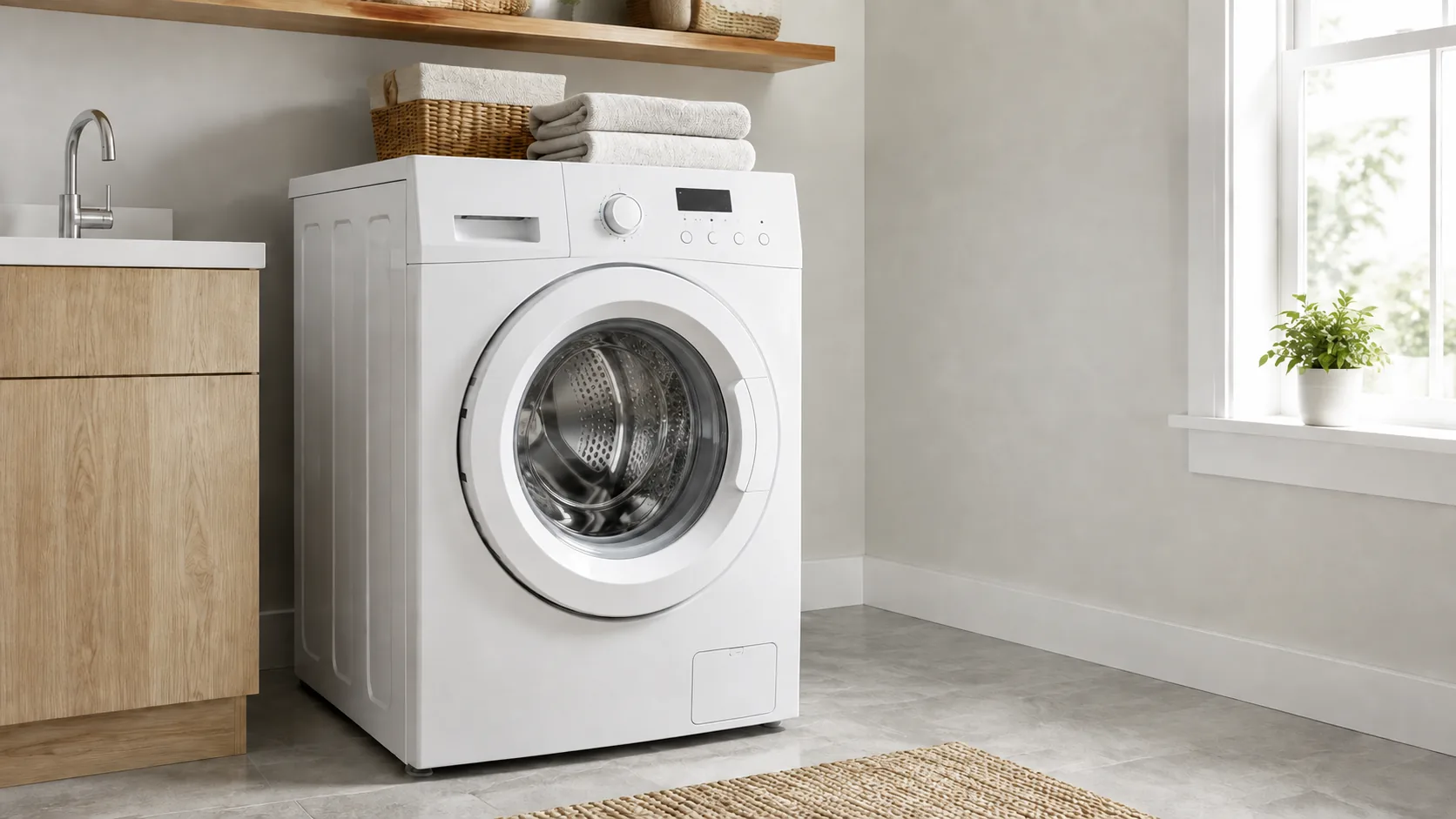
Front load washer dimensions for most full-size models are about 27 inches wide, 38 to 40 inches high, and 30 to 35 inches deep. Some full-size models are 28 inches wide, while many compact front loaders are around 24 inches wide. Those measurements describe the appliance itself, not necessarily the total space required to install and use it.
For an accurate fit, check four separate measurements: the washer’s closed dimensions, the space required behind it for connections, its depth with the door open, and the narrowest opening along the delivery path. In verified examples from major manufacturers, full-size washers ranged from 27 to 28 inches wide and extended from about 52.7 to 56.5 inches deep with the door fully open. Exact dimensions and required clearances vary by model.
| Measurement | Useful planning range | What to verify |
|---|---|---|
| Width | About 27 to 28 inches for many full-size models | Exact cabinet width and side clearances |
| Height | About 38 to 40 inches | Leveling feet, countertop, shelf, and pedestal |
| Closed depth | About 30 to 35 inches | Whether the listed depth includes the door and rear projections |
| Depth with door open | About 53 to 57 inches in the full-size examples reviewed | Exact 90-degree open-door depth and nearby obstructions |
| Compact width | Often about 24 inches | Exact model dimensions and capacity |
These ranges are for early planning, not final installation. Always use the specification sheet and installation instructions for the exact model you plan to buy.
Standard Front Load Washer Dimensions
A 27-inch width is common among full-size front load washers in the United States. Height is frequently close to 39 inches, while depth varies more noticeably. A shallow full-size model may be near 30 inches deep, but a higher-capacity model can exceed 34 inches.
That is why the phrase “standard front load washer dimensions” should be treated as a starting point. It is not a construction standard that guarantees every washer will fit the same opening. Even machines with the same 4.5-cubic-foot capacity can have different cabinet depths, door projections, and installation requirements.
Full-size versus compact front load washers
Many full-size front loaders are 27 or 28 inches wide. Compact front load washers are often around 24 inches wide and are usually shorter and shallower. Compact models deserve separate consideration because their capacity, matching dryer, electrical needs, and stacking options may differ from full-size machines.
If you are planning an entire laundry pair rather than one washer, start with the broader washer and dryer dimensions guide. For a vertical installation, use the dedicated stackable washer and dryer dimensions guide.
Verified Front Load Washer Size Comparison
The following examples show how real full-size models vary. The figures come from manufacturer product pages or planning documents. They are examples, not a promise that every current or future model will fall inside the same range.
| Example model | Capacity | Width | Height | Closed depth | Depth with door open |
|---|---|---|---|---|---|
| LG WM4000HWA | 4.5 cu. ft. | 27 in. | 39 in. | 30.25 in. | 55 in. |
| Samsung WF45B6300AW | 4.5 cu. ft. | 27 in. | 38.75 in. | 31.375 in. | 52.6875 in. |
| Whirlpool WFW5605MW/MC | 4.5 cu. ft. | 27 in. | 38.625 in. | 31.5625 in. | 54.875 in. |
| GE GFW550SSNWW | 4.8 cu. ft. | 28 in. | 39.75 in. | 32 in. | 54.5 in. |
| Whirlpool WFW6605MW/MC | 5.0 cu. ft. | 27 in. | 38.625 in. | 33.25 in. | 56.5 in. |
Sources: Manufacturer specifications for the LG WM4000HWA, Samsung WF45B6300AW, GE GFW550SSNWW, and the Whirlpool WFW5605MC and WFW6605MC comparison. Manufacturer specifications can change, so confirm the current document for the exact model suffix before ordering.
The comparison reveals two useful patterns. Width and height stay relatively consistent across these examples, but closed depth and open-door depth do not. Capacity alone also cannot tell you the exterior size. Compare the actual specification sheet with your measurements before ordering.
Closed Depth, Installed Depth, and Door-Open Depth
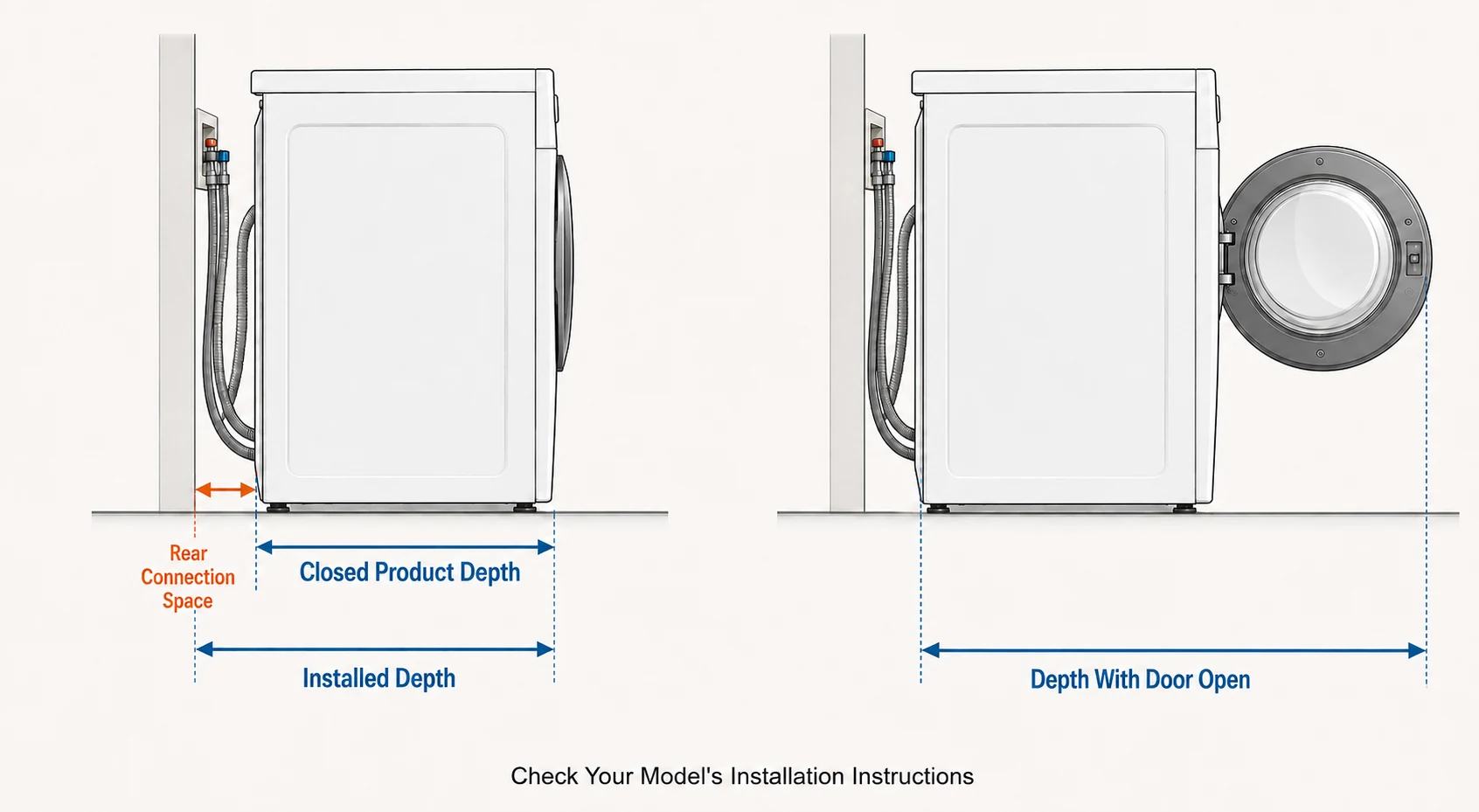
Depth causes more fit problems than width because one washer can have three useful depth measurements. Keeping them separate makes a fit check much clearer.
1. Closed product depth
This is the depth shown in the model specifications. Check the manufacturer’s dimension drawing to learn exactly where the measurement starts and ends. Depending on the model, a front door, control panel, hose connection, or other projection may affect the overall measurement.
2. Installed depth
Installed depth is the distance the washer occupies after allowing room behind it for the water hoses, drain hose, power cord, airflow, and any model-specific requirement. It can be greater than the listed product depth.
For example, the LG WM4000HWA planning sheet calls for at least 4 inches behind the washer and lists a 34.25-inch cutout depth for its 30.25-inch-deep cabinet. Whirlpool’s general laundry sizing guide uses a more generous 6-inch planning allowance behind laundry appliances. These figures serve different contexts, so neither should be applied to every front load washer.
For a preliminary calculation, use:
Required installed depth = closed product depth + the model-specific rear space
Then compare that result with the usable depth of your laundry area. If the manufacturer provides a finished cutout or installation depth, use that documented figure instead of creating your own allowance.
3. Depth with the door open
Front load washer doors swing into the room. In the examples above, the total manufacturer-listed depth with the door open ranges from about 52.7 to 56.5 inches. That measurement helps you check whether the door will strike an opposite wall, closet door, cabinet, sink, or another appliance.
Also inspect the hinge side. A washer may fit inside an opening but still be awkward to use if a side wall prevents its door from opening far enough for easy loading and unloading. Door swing direction is model-specific; some washer doors are reversible, while others are not.
How to Measure for a Front Load Washer
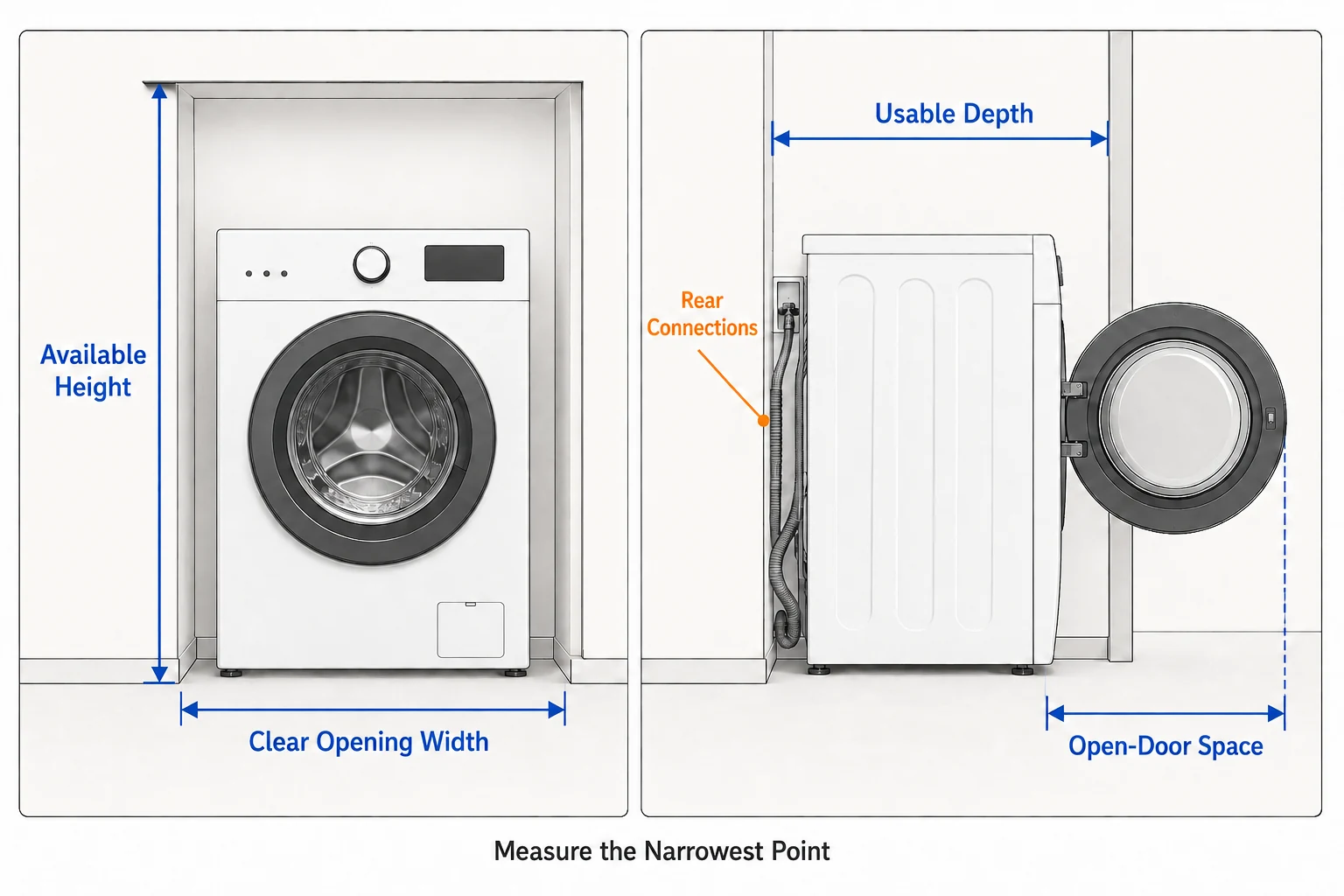
Measure the actual installation area before choosing a model. Do not rely only on the dimensions of the washer you are replacing because the new model may have a different door shape, rear connection layout, or required clearance.
- Measure the clear opening width. Measure between the closest points of the door frame, trim, hinges, or folding doors.
- Measure the interior width. Check the space near the floor, middle, and top. Walls and cabinets are not always perfectly square.
- Measure the available height. Include low shelves, countertops, cabinets, and any trim above the appliance.
- Measure the usable depth. Measure from the rear obstruction to the point where the washer front or laundry door must remain.
- Locate every connection. Note the water valves, standpipe or drain, outlet, baseboard, and anything that could occupy space behind the washer.
- Check open-door space. Measure forward from the planned rear position and check the hinge side for walls or cabinets.
- Measure the complete delivery path. Check exterior doors, hallways, stair turns, railings, and the laundry-area doorway at their narrowest usable points.
A 27-inch washer does not automatically pass through a doorway described as 27 inches wide. The clear opening can be reduced by the door itself, hinges, stops, handles, or trim. Delivery crews also need enough room to control and turn a heavy appliance safely.
Check width at more than one height
Baseboards can make the bottom of a laundry alcove narrower than the wall-to-wall measurement above them. Plumbing boxes or side trim can create the same problem. Record the smallest usable dimension, not the largest one.
Measure for side-by-side use
If the washer will sit beside a dryer, do not simply double the width of one appliance. Add both exact product widths plus the clearances specified for the selected models. The side-by-side washer and dryer dimensions guide explains the complete pair measurement.
How a Pedestal Changes Washer Height
A pedestal raises the washer door and may provide storage, but it also changes the total height and sometimes the effective depth of the setup. Compatible pedestal heights are not universal. A pedestal from one product line should not be assumed to fit or safely support a different washer.
Use this planning calculation:
Total washer height = washer height with adjusted feet + compatible pedestal height
Check the resulting height against shelves, cabinets, countertops, and wall-mounted controls. If the pedestal has a drawer, verify its fully extended depth and confirm that it will not collide with a door or wall. A washer installed on a pedestal also needs the manufacturer-approved mounting method.
Do not put a pedestal beneath a stacked washer and dryer unless the manufacturer explicitly approves that complete configuration. The dedicated stacking instructions and compatible stacking kit control a stacked installation.
Front Load Washer Fit Worksheet
Complete this worksheet for the exact model you are considering. Use manufacturer documents for the washer column and your own measurements for the space column. Tap each field to enter a measurement or choose a result; entries may clear when the page is refreshed.
| Fit check | Washer or requirement | Your available space | Pass or needs review |
|---|---|---|---|
| Product width plus required side space | |||
| Height with adjusted feet | |||
| Height with pedestal, if used | |||
| Required installed depth | |||
| Total depth with washer door open | |||
| Narrowest delivery opening | |||
| Hinge-side door clearance | Manufacturer drawing checked | Obstruction checked |
Do not treat a borderline result as an automatic pass. Confirm how the washer will be moved into position and how the installer will reach the shutoff valves, drain, outlet, and hose connections. A machine that technically fits can still be difficult to install, service, or remove.
Common Front Load Washer Measuring Mistakes
- Shopping by nominal width alone: A “27-inch washer” still needs model-specific side space and a usable delivery opening.
- Treating listed depth as installed depth: Rear connections can move the washer farther into the room.
- Forgetting the open door: The cabinet may fit while the door strikes an opposite wall or closet door.
- Assuming capacity determines exterior size: Two washers with similar drum capacities can have different depths.
- Ignoring adjustable feet: The installed height can change when the washer is leveled.
- Measuring only inside the laundry area: The appliance still has to pass through every doorway, hall, and turn.
- Adding a generic rear allowance: Use the exact model’s installation instructions instead of assuming one clearance applies to every washer.
- Forgetting pedestal height: A pedestal can create a conflict with a shelf, countertop, or cabinet.
Final Fit Check Before Buying
Use typical front load washer dimensions only to narrow your search. Before ordering, download the exact model’s specification sheet and installation instructions. Confirm the product width, adjusted height, closed depth, rear connection space, open-door depth, hinge clearance, pedestal compatibility, and delivery path.
If every measurement passes with enough room for installation and normal use, the washer is a practical fit. If even one measurement is unclear, resolve it with the manufacturer or installer before purchasing rather than assuming the appliance can be squeezed into place.